There is a version of language learning that lives in comfortable classrooms. You conjugate verbs, you memorize vocabulary lists, and you practice ordering coffee. It is pleasant. It is useful. But it is not urgent.
Then there is another version. The version where the words you learn might one day matter more than any exam score. The version where a single phrase, spoken clearly and at the right moment, could help someone find a hospital, escape a fire, or simply know that they are not alone.
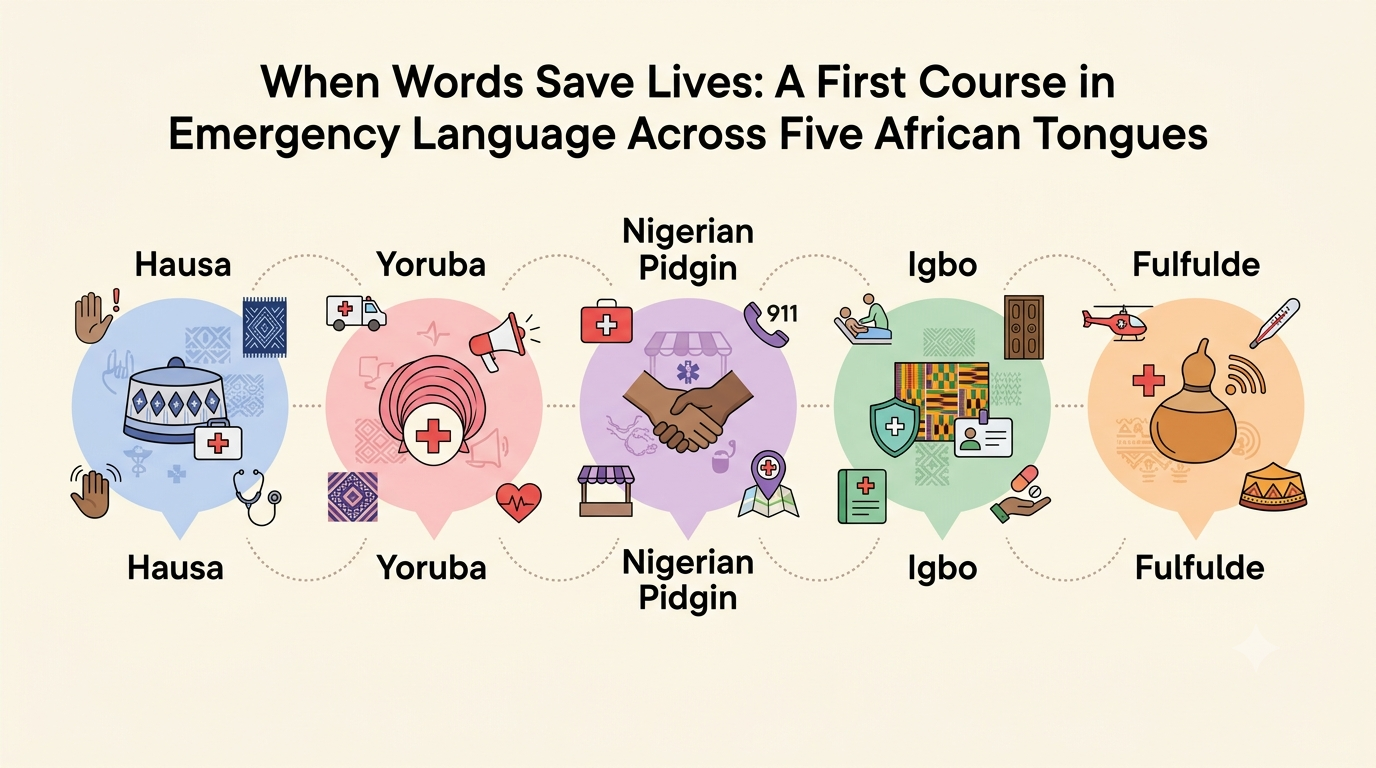
This course is about that second version. We are going to explore fifty questions and answers about emergencies across five languages: Swahili, Oromo, Amharic, Fulani, and Lingala. These are the phrases you hope you will never need. But if you do need them, they will be waiting.
Let us begin.
---
Why Emergency Language Matters
Africa is a continent of immense diversity, but it is also a continent where daily life can present sudden challenges. A road accident on a busy highway in Tanzania. A medical crisis in a remote village in Ethiopia. A fire in a crowded market in Kinshasa. A flood during the rainy season in the Sahel.
In these moments, communication is not a luxury. It is a lifeline. And in many of these places, English or French may not be the first language of the person who needs help. The mother who is rushing her child to a clinic may speak only Oromo. The trader whose stall is burning may speak only Lingala. The traveler who has collapsed at a bus station may speak only Fulani.
If you are the person standing nearby, the ability to ask a single question in the right language can change everything. Where does it hurt? Is there a doctor? How can I help?
This course is not about becoming fluent. It is about becoming useful. It is about having the right words at the right time.
---
The Fifty Questions and Answers
Below are fifty questions and answers organized by emergency type. Not every language has a direct translation for every phrase, but these are the ones that travel best. Learn them in the language you are most likely to encounter, or learn a few in each. The goal is recognition and response.
Medical Emergencies
# English Swahili Oromo Amharic Fulani Lingala
1 Help! Msaada! Gargaarsa! Irdata! Wallo! Salissa ngai!
2 I need a doctor Nahitaji daktari Doktora nan barbaada Doktor ihitagnalehu Mi nani doktoor Nazali na dokitolo
3 Where is the hospital? Hospitali iko wapi? Hospitaalli eessa? Hospital yet no? Safrirde ndeye? Lipitalo ezali wapi?
4 Is there a clinic nearby? Kuna kliniki karibu? Kiliinikii dhiyoo jiraa? Klinik biyachin al? Klinik ɓadiiɗo woni? Kliniki pene ezali?
5 I am sick Ninaumwa Nan dhukkubsadha Amognalehu Mi naɓa Nazali na bokono
6 Where does it hurt? Unaumwa wapi? Eessa si dhukkuba? Yet yamogn? Ɗe tammbi? Ezali pasi wapi?
7 I have a fever Nina homa Ho'a qaba Bukam aleh Mi naɓa ndiyam Nazali na fievre
8 I cannot breathe Siwezi kupumua Afuura ba'uu hin danda'u Mafesasem alchilim Mi waawi foofaade Nakoki kopema te
9 Call an ambulance Ita gari la wagonjwa Ambulaansii waami Ambulans t'eyi Noddu ambulans Benga ambulans
10 Is there a pharmacy? Kuna duka la dawa? Qoricha dukaani jiraa? Farmasi al? Duɗal lekki woni? Famasi ezali?
Accidents and Injuries
# English Swahili Oromo Amharic Fulani Lingala
11 There has been an accident Kuna ajali Balaa ta'eera Adaya tefetsere Aksida waɗii Aksida esalaki
12 I am injured Nimejeruhiwa Nan miidhame Dersalehu Mi mawɗi Nazali na bobo
13 I am bleeding Ninavuja damu Dhiigni na dhiiga Dam iyayen Mi yaltii Makila ezali koti
14 He is unconscious Amepoteza fahamu Isaan hin beeku Honehoneh O walaa hakkil Azali na koyeba te
15 She has broken her leg Amevunjika mguu Miilli ishee cabsite Igrih tesebera O fusi koyngal Lokolo na ye ebukani
16 Do not move him Usimsogeze Isaa hin sochoosin Atinikisew Taa momtu mo Kobongola ye te
17 Call the police Ita polisi Poolisii waami Police t'eyi Noddu polis Benga polisi
18 There is a fire Kuna moto Ibiddi jira Isat al Yiite woni Moto ezali
19 I have been robbed Nimeibiwa Nan hattatame Tewatimalehu Mi wujjaama Nayibaki
20 Where is the police station? Kituo cha polisi kiko wapi? Poolisii buufata eessa? Police steshin yet no? Polis station ndeye? Poste ya polisi ezali wapi?
Natural Disasters and Danger
# English Swahili Oromo Amharic Fulani Lingala
21 There is a flood Kuna mafuriko Lolaa jira Yiflet al Ilam woni Mbonge ezali
22 There is an earthquake Kuna tetemeko la ardhi Sochii lafa jira Yemerdim ts'efa Lardi ndirgi Mabelé eninginiki
23 Run! Kimbia! Fiigi! Ruti! Doggu! Pota!
24 Get out! Toka! Ba'i! Wita! Yaltu! Basika!
25 It is dangerous Ni hatari Balaa qaba Ayk'ot'aw Hakkilo woni Ezali likambu
26 Do not go there Usiende huko Achii hin dandeessu Ahed temhed Taa yahu to Kende kuna te
27 We need to evacuate Tunahitaji kuondoka Ba'uu qabna Inwelikalehu Min nani doggude Tosengeli kobima
28 Where is the safe place? Mahali salama ni wapi? Bakka nagaa eessa? Zemen bet yet no? Nokku jam ndeye? Esika ya kimya ezali wapi?
29 Is everyone okay? Kila mtu yuko salama? Namni hundi nagaa? Hulumm dehna? Yimɓe fuu jam? Bato nyonso malamu?
30 I am lost Nimepotea Nan badadhe T'omalehu Mi majjii Nabungi
Asking for and Offering Help
# English Swahili Oromo Amharic Fulani Lingala
31 Can you help me? Unaweza kunisaidia? Na gargaaruu dandeessaa? Lirdagnaleh? A waawi wallude lam? Okoki kosalisa ngai?
32 I can help you Naweza kukusaidia Si gargaaruu nan danda'a Lirdagnalehu Mi waawi wallude ma Nakoki kosalisa yo
33 What happened? Nini kilitokea? Maal ta'e? Min tefetsere? Ko waɗi? Nini esalaki?
34 Are you okay? Uko salama? Nagaa jirtaa? Dehna neh? A jam naa? Ozali malamu?
35 I do not understand Sielewi Hin hubadhu Algebagnem Mi famali Nazali kososola te
36 Speak slowly, please Tafadhali sema polepole Maaloo suuta dubbadhu Be'istu yemilwetu Achu haké hal cess Loba malembe
37 Do you speak English? Unazungumza Kingereza? Afaan Ingiliizi beekta? English tenagereh? A don wolwa Anglais? Olobaka Lingelésa?
38 I am learning your language Ninajifunza lugha yako Afaan kee barachaa jira Qwanqwahesh iyetenarku new Mi ekkita ɗemngal ma Nazali koyekola monoko na yo
39 Thank you for your help Asante kwa msaada wako Gargaarsa keetiif galatoomi Lirdagneti ameseginalow Jaraama ballal ma Matondi mpo na lisalisi na yo
40 I will call for help Nitaita msaada Gargaarsa nan waama Lirdagnalehu Mi noddoto wallo Nakobenga lisalisi
Location and Transport Emergencies
# English Swahili Oromo Amharic Fulani Lingala
41 Where is the nearest exit? Njia ya kutokea iko wapi? Karaa ba'uu eessa? Mets'i yet no? Laawol yaltugol ndeye? Nzela ya kobima ezali wapi?
42 Stop the car! Simamisha gari! Konkolaadha dhaabi! Mekina asiT'ew! Dartu mota! Telisa motuka!
43 I need a taxi Nahitaji teksi Taaksii nan barbaada Taxi ihitagnalehu Mi nani taksi Nazali na taksi
44 Take me to the hospital Nipeleke hospitalini Hospitaalatti na geessi Wede hospital Naanu safrirde Kumba ngai na lipitalo
45 Is this the road to the clinic? Hii ni njia ya kliniki? Kun karaa kiliinikii ti? Yih klinik menged new? Ndun laawol klinik? Oyo nzela ya kliniki?
Reassurance and Comfort
# English Swahili Oromo Amharic Fulani Lingala
46 Everything will be okay Kila kitu kitakuwa sawa Wanti hundi nagaa ta'a Hulumm dehna yihonal Koo fuu jam Nyonso ekosalema
47 Stay calm Tulia Tasgabbii Dinq yibel A jokku Kimya
48 I am here with you Niko nawe Si sii jira Kegna alehu Mi woni e ma Nazali na yo
49 Do not worry Usijali Hin yaadin Atich'aw Taa hakkillo ɓiɗu Kobanga te
50 You are safe now Uko salama sasa Amma nagaa jirta Ahun dehna neh Jooni a jam Sikoyo ozali malamu
---
The Grammar of Urgency
Emergency language has its own grammar. It is short. It is direct. It does not waste words.
In Swahili, commands are often formed with the imperative. Kimbia! means "Run!" Toka! means "Get out!" The verb comes first, stripped of politeness markers, because in an emergency, there is no time for decoration.
In Oromo, the imperative is similarly direct. Fiigi! means "Run!" Ba'i! means "Get out!" The language does not soften these commands. It delivers them like a slap.
Amharic uses the imperative form as well. Ruti! means "Run!" Wita! means "Get out!" But Amharic also has a polite imperative, which is used when speaking to elders or strangers. Even in emergencies, respect matters.
Fulani commands are softened by the cultural emphasis on semteende—modesty and restraint. But in a true emergency, the words become sharp. Doggu! means "Run!" Yaltu! means “Get out!”
Lingala, the language of the streets, is perhaps the most direct of all. Pota! means "Run!" Basika! means "Get out!" There is no time for ceremony.
---
How to Practice Emergency Language
You cannot practice emergencies the way you practice ordering coffee. But you can prepare.
Learn the five most critical phrases in each language. Help. Doctor. Hospital. Run. Get out. These are the words that matter most.
Practice out loud. Emergency language must be automatic. You cannot be searching your memory when someone is bleeding. Say the phrases until they live in your mouth.
Teach someone else. The best way to learn is to teach. Share these phrases with a friend. Practice the call and response.
Learn the numbers. Emergency services often require phone numbers. Learn how to say 1 through 10 in the language you are studying.
Know the context. In some regions, the police are trusted. In others, they are not. In some places, the hospital is far away. In others, it is around the corner. Language is not just words. It is knowledge.
---
The Fifty-First Question
There is one question that is not on the list. It is the question you ask yourself before you speak: Am I willing to help?
Language is a tool. But the hand that holds the tool must be willing to use it. You can learn every phrase in this course, but if you walk past the person who needs them, the words are useless.
So learn these phrases. Carry them with you. And when the moment comes—if the moment comes—speak.

Leave a comment
Your email address will not be published. Required fields are marked *