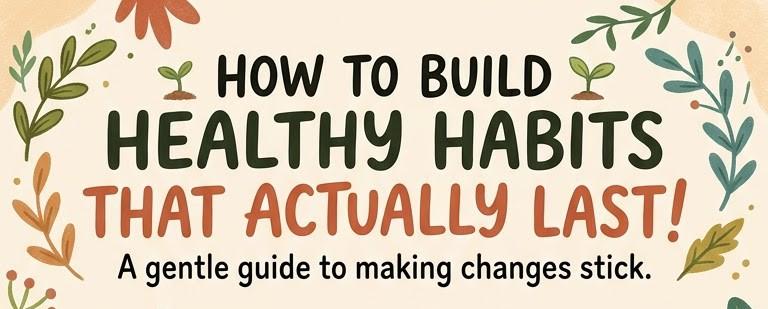
Have you ever decided to wake up earlier, exercise regularly, read more books, save money, or spend less time on your phone, only to abandon the plan after a few days?
You are not alone. Many people begin new habits with enthusiasm but struggle to maintain them when life becomes busy, motivation fades, or progress seems too slow.
The problem is not always a lack of discipline. Sometimes, the habit is too ambitious, the plan is unrealistic, or the environment makes the desired behaviour unnecessarily difficult.
Building a lasting habit requires more than promising yourself that you will do better tomorrow. It involves creating a system that makes the behaviour easier to repeat, even on days when you do not feel motivated.
Here are practical ways to build healthier habits and make them part of your everyday life.
1. Start Smaller Than You Think You Should
One of the most common mistakes people make is trying to change too much at once.
Someone who rarely exercises might decide to work out for an hour every morning. A person who has not read regularly for years might set a target of finishing an entire book every week.
These goals may sound impressive, but they can become difficult to maintain when enthusiasm disappears.
Instead, begin with a version of the habit that feels manageable.
For example:
- Read two pages of a book each day.
- Walk for five minutes after lunch.
- Save a small, affordable amount whenever you receive income.
- Spend ten minutes learning a useful skill.
- Put your phone away for the first fifteen minutes after waking up.
The purpose of starting small is to make repetition easier. Once the behaviour becomes familiar, you can gradually increase the difficulty.
A small habit that you practise consistently can provide a stronger foundation than an ambitious routine you abandon after a week.
2. Connect Your New Habit to an Existing Routine
Remembering to perform a new behaviour can be surprisingly difficult, especially when your daily schedule is unpredictable.
One solution is to connect the new habit to something you already do.
For example, you could decide to stretch after brushing your teeth, review your daily priorities after breakfast, or read a few pages before going to bed.
This gives the new behaviour a clear starting point.
Instead of telling yourself, "I will exercise sometime today," make the plan more specific: “After I change out of my work clothes, I will take a ten-minute walk.”
The more clearly you define when and where a habit will happen, the easier it becomes to remember and repeat.
Choose an existing routine that occurs reliably, and attach your new behaviour to it.
3. Make the Desired Behaviour Easier
Your environment can influence your behaviour more than you realise.
If your running shoes are hidden in a cupboard, your exercise clothes are difficult to find, and you have no idea when you will exercise, getting started requires several small decisions.
You can reduce that friction by preparing in advance.
Place your shoes somewhere visible. Choose your workout clothes the night before. Prepare your study materials before going to bed. Keep a reusable water bottle where you can easily reach it.
The same principle works for financial habits. If you want to save money, you could schedule a transfer to a savings account when you receive your income, provided the arrangement fits your budget and does not interfere with essential expenses.
Make the behaviour you want to encourage convenient, and remove unnecessary obstacles wherever possible.
You do not have to depend on willpower for every step if you can design your surroundings to support your goals.
4. Understand What Triggers Your Unwanted Habits
Building better habits is not only about adding positive behaviours. Sometimes, it also means understanding why you repeatedly do things you want to change.
Consider someone who spends hours scrolling through social media whenever they feel stressed.
The behaviour may not be caused simply by poor time management. Opening the app might provide temporary distraction, relief from boredom, or a way to avoid an uncomfortable task.
Understanding the trigger can help you choose a more effective response.
For example:
- If boredom leads to endless scrolling, prepare a short list of alternative activities.
- If stress leads to unnecessary shopping, try pausing before purchasing anything that is not essential.
- If difficult tasks lead to procrastination, break the work into smaller steps.
- If late-night phone use affects your sleep routine, charge your phone away from your bed.
The goal is not to criticise yourself. It is to recognise the circumstances surrounding the behaviour and create a healthier alternative.
5. Track Your Progress Without Becoming Obsessed
Tracking a habit can help you see whether you are following through on your intentions.
You might use a calendar, notebook, simple checklist, or habit-tracking application. Each time you complete the behaviour, mark it down.
For instance, if your goal is to practise a new skill for fifteen minutes each day, record the days you complete your session.
Over time, the record can reveal useful patterns. You might discover that you practise more consistently in the morning or that your routine becomes difficult to maintain on particularly busy days.
However, tracking should support your progress, not become another source of pressure.
Missing a day does not erase the effort you have already invested. Use your record to identify what needs adjusting rather than treating every missed entry as a personal failure.
6. Prepare for Days When Motivation Is Low
Motivation naturally changes. You may feel enthusiastic at the beginning of the week but exhausted by Friday.
If your habit depends entirely on feeling motivated, it may become difficult to maintain.
Prepare a minimum version of your routine for challenging days.
If your usual workout lasts thirty minutes, your minimum version might be a short walk or a few gentle movements appropriate for your ability.
If you normally study for an hour, you could review one important concept when time is limited.
If you are working on a writing project, you might write one paragraph instead of completing an entire section.
This approach helps you preserve the connection between the situation and the behaviour without demanding the same performance every day.
There will also be occasions when rest is the healthier choice. Illness, exhaustion, family responsibilities, and unexpected emergencies can justify adjusting your routine.
Consistency does not mean ignoring your needs. It means returning to your habit when circumstances allow.
7. Choose Habits That Fit Your Actual Life
It is easy to copy a routine from someone who appears successful online. You might see a person waking up at 4 a.m., exercising for an hour, reading several books, and completing a long list of tasks before breakfast.
That routine may work for them, but it may not suit your circumstances.
Your working hours, family responsibilities, finances, health, living environment, and energy levels all influence what is realistic.
For example, a parent caring for young children may need a different exercise schedule from someone with a flexible workday. Someone working night shifts may not benefit from advice that assumes everyone should wake up early in the morning.
Build habits around the life you actually have.
Ask yourself:
- When do I realistically have time for this?
- What resources do I need?
- What might interrupt my routine?
- How can I adapt the habit when my schedule changes?
A practical routine that fits your circumstances is more useful than an ideal routine you cannot sustain.
8. Give Yourself a Clear and Meaningful Reason
A habit becomes easier to prioritise when you understand why it matters to you.
Instead of setting a vague goal such as "I want to be more productive," identify what you hope to achieve.
Perhaps you want to learn a skill that could improve your career opportunities. You may want to save money to prepare for unexpected expenses. You might want to walk regularly because you enjoy the activity and want to support your general well-being.
Write down your reason and keep it somewhere you can review when your enthusiasm decreases.
Your reason does not need to impress anyone else. It needs to matter to you.
It is also helpful to distinguish between goals you genuinely value and goals you pursue mainly because of pressure from friends, family, or social media.
You are more likely to remain committed to a habit when it supports a meaningful personal priority.
9. Make Your Progress Visible and Reward Your Effort
Some habits produce results slowly.
Learning a language, developing professional skills, improving your fitness, and building a savings balance may require sustained effort before the benefits become obvious.
When progress is difficult to see, it can be tempting to stop.
Look for smaller signs of improvement along the way.
If you are learning a skill, compare your current work with an earlier attempt. If you are saving money, record how your balance changes over time. If you are developing a reading routine, keep a list of the books or chapters you complete.
You can also give yourself a modest, healthy reward for reaching a meaningful milestone.
For example, after completing a planned series of study sessions, you might spend time on a favourite activity or enjoy an inexpensive treat.
The reward does not need to be expensive. The important thing is to recognise your effort and maintain a positive relationship with the process.
10. Review Your Routine and Adjust It
A habit that works well today may become difficult when your circumstances change.
You might start a new job, begin a course, take on additional responsibilities, or discover that your original plan was too demanding.
Rather than abandoning the habit completely, review the arrangement.
Ask yourself:
- Is the habit still connected to a goal I care about?
- Is my schedule realistic?
- What repeatedly prevents me from following through?
- Can I make the behaviour easier?
- Would a different time or method work better?
For example, if evening exercise repeatedly fails because you return home exhausted, a short morning session or a lunchtime walk might be more practical.
If daily study sessions are difficult to maintain, you could begin with a smaller number of planned sessions each week.
Adjusting your approach is not necessarily a sign of failure. It can be evidence that you are learning what works for you.
A Simple Seven-Day Plan for Starting a New Habit
If you want to put these ideas into practice, try the following one-week approach.
Day 1: Choose one habit. Select something specific that supports a goal you care about.
Day 2: Make it small. Reduce the habit to a version you can complete in a few minutes.
Day 3: Choose a trigger. Decide when and where you will perform it, preferably after an existing routine.
Day 4: Prepare your environment. Put the necessary tools or materials somewhere convenient.
Day 5: Track your effort. Record whether you completed the habit and note any difficulties.
Day 6: Identify an obstacle. Consider what could make the habit difficult and prepare a realistic alternative.
Day 7: Review the week. Look at what worked, what did not, and what you want to change for the following week.
Seven days will not necessarily establish a permanent habit, but they can help you create a practical starting point. Continue adjusting and repeating the behaviour over the following weeks.
Final Thoughts
Healthy habits are rarely built through one dramatic decision. They develop through repeated actions, realistic expectations, and the willingness to begin again when circumstances change.
You do not need to transform your entire life in one week. Choose one behaviour, make it manageable, and create a clear plan for repeating it.
When the routine becomes easier, you can gradually build on it.
Remember that the purpose of a habit is to support your life, not to make you feel guilty whenever your plans change. Progress will not always be perfectly consistent, and that is normal.
Choose one small habit you can begin today. Make it easy to repeat, track your effort, and give yourself permission to improve gradually.

Leave a comment
Your email address will not be published. Required fields are marked *