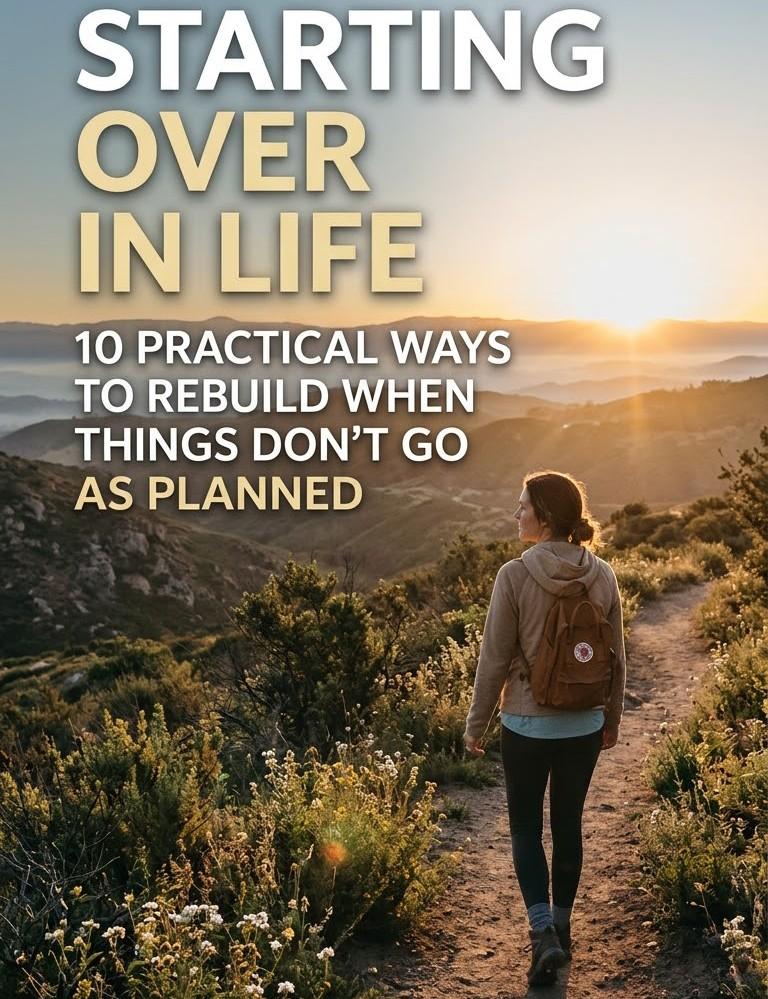
Life does not always follow the direction we expect.
You might spend years working towards a particular goal only to discover that the opportunity is no longer available. A business may fail, a relationship may end, or financial difficulties may force you to reconsider your plans.
Sometimes, the changes happen gradually. Other times, one unexpected event can make the future feel completely different from what you imagined.
Starting over can be difficult because you are not simply facing a new situation. You may also be dealing with disappointment, uncertainty, embarrassment, or the feeling that you have lost valuable time.
You might look at people around you and wonder why their lives seem to be moving forward while you are trying to rebuild yours.
But starting over does not mean that everything you have experienced was wasted. Your knowledge, skills, mistakes, and experiences can help you make better decisions as you move forward.
You may not be able to change everything that happened, but you can begin taking steps towards a different future.
Here are ten practical ways to approach a fresh start.
1. Accept Your Current Situation Without Defining Yourself by It
One of the first challenges of starting over is accepting that your circumstances have changed.
Perhaps you are unemployed after years of working. Maybe a business you invested in did not succeed. You might have abandoned an educational path or realised that your previous goals no longer fit your life.
It is natural to feel disappointed when reality differs from what you expected.
However, there is an important difference between acknowledging a difficult situation and treating it as proof that you are incapable.
You can admit that a business failed without deciding that you will never become a successful entrepreneur.
You can acknowledge that a relationship ended without believing that you are unworthy of love.
You can recognise that you made poor decisions without concluding that your future must follow the same pattern.
Your circumstances describe where you are now. They do not automatically determine everything you can become.
Start by identifying the facts of your situation. What has changed? What responsibilities do you have? Which resources remain available to you? What needs immediate attention?
Clear answers can help you respond to reality rather than becoming trapped in harsh judgments about yourself.
2. Give Yourself Time to Process What Happened
When something important falls apart, people sometimes feel pressure to move on immediately.
They may tell themselves to stop thinking about the past, pretend that they are fine, or rush into a new project to avoid uncomfortable emotions.
Although taking action can be helpful, ignoring your feelings does not always make them disappear.
Disappointment, grief, anger, and uncertainty can all be understandable responses to major changes.
Give yourself reasonable time to process what happened.
You might write down your thoughts, speak with someone you trust, take a walk, or spend some quiet time identifying what you are feeling.
If the experience has affected your mental health or ability to function, consider seeking support from a qualified professional.
Processing an experience does not mean allowing it to control your life indefinitely. It means acknowledging what happened so that you can begin deciding what comes next.
You do not have to pretend that losing something important was easy.
You can recognise the pain and still believe that a meaningful future remains possible.
3. Stop Comparing Your Recovery With Other People's Progress
Starting over can feel particularly painful when you see people around you achieving things you once hoped to achieve yourself.
A former classmate may secure a good job. A friend may launch a successful business. Someone you know may appear to have financial stability, a happy relationship, and a clear direction in life.
Meanwhile, you may be trying to solve problems that other people do not know you are facing.
These comparisons can make you feel as though you are falling behind.
However, you rarely have enough information to compare two people's lives fairly. You may not know what difficulties another person has experienced, what support they received, or what compromises they have made.
More importantly, their progress does not mean that your opportunity to grow has disappeared.
You can admire someone else's achievements without treating them as evidence of your own failure.
If certain online content makes you feel consistently inadequate, consider limiting your exposure to it.
Use the time you regain to focus on your own circumstances, responsibilities, and goals.
Your next step should be determined by what you need to do, not by how quickly someone else appears to be progressing.
4. Take an Honest Look at What Went Wrong
A fresh start gives you an opportunity to examine your previous decisions.
This does not mean blaming yourself for every problem. Many situations involve circumstances beyond your control, including economic changes, unexpected expenses, health challenges, and decisions made by other people.
However, there may also be lessons you can take from your experience.
If a business failed, perhaps you need to understand your customers better, manage expenses differently, or test your idea before investing heavily.
If you repeatedly struggled to complete important goals, perhaps your plans were unrealistic or your daily routine made consistent effort difficult.
If a relationship became unhealthy, you might need to recognise patterns involving communication, expectations, or personal boundaries.
Try asking yourself:
- What factors contributed to the situation?
- Which parts were outside my control?
- Which decisions could I have handled differently?
- What warning signs did I overlook?
- What will I do differently next time?
Answer these questions as honestly as possible without turning reflection into self-punishment.
The goal is not to spend the rest of your life analysing the past. It is to identify useful lessons that can improve your future decisions.
5. Start With What You Have, Not What You Wish You Had
When people imagine rebuilding their lives, they sometimes focus on everything they lack.
They may wish they had more money, better connections, additional qualifications, expensive equipment, or someone who could provide financial support.
These resources can certainly make some goals easier to pursue.
However, waiting until every condition is perfect can prevent you from taking the first step.
Instead, make an inventory of what is currently available to you.
Consider your existing knowledge, practical skills, relationships, available time, equipment, and access to learning resources.
Perhaps you have a smartphone and an internet connection that allow you to study, communicate with potential customers, or explore work opportunities.
Maybe you have experience in a particular industry that could help you find another job or offer a useful service.
You might know someone who can provide advice or introduce you to a relevant opportunity.
These resources may not solve every problem, but they can help you identify realistic starting points.
For example, if you want to learn a digital skill but cannot afford an expensive course, investigate reputable free learning materials before spending money.
If you want to start a small business, consider researching demand and testing your idea on a limited scale.
Beginning with limited resources does not guarantee success. It simply allows you to explore what is possible before deciding what additional resources you need.
6. Set Small Goals That You Can Actually Complete
When you feel dissatisfied with your life, you may want to change everything immediately.
You might decide to earn more money, improve your health, learn several skills, rebuild your relationships, and launch a business within a few months.
Although ambition can be useful, trying to change too many things at once can leave you overwhelmed.
Start by identifying the area that needs attention most urgently.
If your finances are unstable, your first priority might be finding reliable income and understanding your essential expenses.
If you have lost direction professionally, you might focus on exploring career options and developing one relevant skill.
If your daily routine has become disorganised, you could begin by creating a manageable schedule.
Turn your priority into smaller actions.
Instead of writing "fix my finances," you might list your current expenses, contact a potential employer, or research a realistic source of additional income.
Instead of writing "change my career," you might spend 30 minutes researching a particular profession or begin a beginner-level course.
Small goals make it easier to see what needs to be done and evaluate whether your efforts are helping.
As you complete each step, you can adjust your plans based on what you learn.
You do not need to solve your entire life in one week.
7. Build a Routine That Supports Your New Direction
Motivation can help you begin a new chapter, but routines can make it easier to continue when enthusiasm fades.
Without a basic structure, days can become filled with distractions, unplanned activities, and postponed responsibilities.
A routine does not need to be complicated.
You might establish a regular time to wake up, identify your most important task for the day, schedule time to learn or work, and set aside a period to review your progress.
If you are looking for employment, your routine could include researching suitable positions, improving your CV, applying for relevant roles, and practising interview questions.
If you are developing a business, you might dedicate time to understanding customers, improving your offer, managing finances, and following up on enquiries.
Make the schedule realistic enough to accommodate your current responsibilities and energy levels.
You should also allow room for rest, recreation, and unexpected events.
The purpose of a routine is not to control every minute of your day. It is to create enough structure to help you make consistent progress.
8. Be Willing to Learn Something New
Sometimes, rebuilding requires more than returning to what you were doing before.
The experience that changed your circumstances may also reveal that you need different skills, a new strategy, or a better understanding of your environment.
For example, someone whose previous business struggled might need to learn more about pricing, customer service, or marketing.
A person changing careers may need to develop skills that are more relevant to the opportunities available to them.
Someone who has repeatedly struggled with budgeting might benefit from learning basic financial management.
Before choosing what to learn, research what is genuinely useful for your goal.
Look at the skills employers request, the problems customers are willing to pay to solve, or the knowledge required to complete a particular task.
Where possible, practise what you learn through projects or real-world activities.
Certificates can be valuable in some fields, but they are not a substitute for the skills and qualifications actually required for a role.
Be patient with yourself while learning. You may feel inexperienced at first, especially if you are comparing your current ability with someone who has spent years developing theirs.
The objective is to become more capable over time, not to master everything immediately.
9. Review Your Relationships and Ask for Support When Needed
Starting over can make you realise how important your relationships are.
Some people may offer practical help, encouragement, useful information, or honest advice.
Others may not understand your situation, and some relationships may become more difficult during periods of change.
Pay attention to the people who treat you with respect and support your efforts to make thoughtful decisions.
You do not need to share every personal detail with everyone. Choose carefully whom you trust with sensitive information or important plans.
At the same time, try not to assume that asking for help makes you weak.
Depending on your circumstances, support might mean asking someone to review your CV, seeking advice from an experienced professional, discussing a financial problem with a trusted person, or finding a community connected to your interests.
If you are facing serious financial, legal, health, or emotional difficulties, the most useful support may come from a qualified professional or an appropriate local service.
You do not have to solve every problem independently.
Rebuilding can become more manageable when you recognise which tasks you can handle yourself and where additional support would make a meaningful difference.
10. Give Your New Beginning Time to Develop
One of the hardest parts of starting over is accepting that meaningful change may take longer than expected.
You might work hard for several weeks without seeing significant results. A new business may take time to attract customers. Learning a skill may require months of practice. Finding suitable employment may involve repeated applications and disappointments.
Slow progress can make you question whether your efforts are worthwhile.
When this happens, review your approach rather than judging your entire future by your most recent result.
Are you developing useful skills? Are you receiving feedback that can help you improve? Is your current strategy producing any meaningful opportunities? Do you need to adjust your expectations or try a different method?
Sometimes, patience is necessary. At other times, a change in strategy is more appropriate.
You do not have to remain committed to a plan that clearly is not working simply because you have already invested time in it.
Give yourself permission to adapt.
A fresh start is not about following one perfect path. It is about making informed decisions as your circumstances and understanding develop.
A Simple 30-Day Plan for Rebuilding Your Direction
If you are unsure where to begin, consider using the next 30 days to create a clearer starting point.
Days 1–7: Understand your situation.
Write down your main responsibilities, immediate challenges, available resources, and most important priorities. Identify any urgent problems that require attention first.
Days 8–14: Choose one main goal.
Select a realistic goal that addresses an important need. Break it into smaller actions and identify the resources or skills required.
Days 15–21: Take consistent action.
Work on the steps you identified. Track what you complete and pay attention to obstacles that make progress difficult.
Days 22–30: Review and adjust.
Look at what you have learned, what worked, and what needs to change. Use that information to plan your next month.
Your progress may be different from someone else's, and you may need to adjust this plan to fit your circumstances.
If you are dealing with an urgent housing, health, safety, or financial problem, addressing that need may take priority over longer-term goals.
Remember that the purpose of the 30-day plan is to create direction, not to demand a complete transformation within a month.
Final Thoughts
Starting over is rarely as simple as deciding to change your life.
It may involve disappointment, difficult choices, financial pressure, and uncertainty about what the future holds.
However, a difficult chapter does not mean that every future chapter must be the same.
Take time to understand what happened. Learn from your experiences without using them to define your worth. Identify the resources available to you, choose realistic priorities, and begin taking practical steps.
Some days will be easier than others. You may need to change your plans more than once.
That is part of rebuilding.
You do not need to have every answer before you begin moving forward. You need a clear enough understanding of your current situation to decide what deserves your attention next.
A fresh start does not erase your past. It gives you an opportunity to use what you have learned to make different choices.
What Do You Think?
Have you ever had to start over after a major disappointment, financial difficulty, failed plan, or unexpected change?
What helped you move forward, and what advice would you give someone who is trying to rebuild their life today?
Share your thoughts in the comments. Your experience may help another reader who is facing a difficult new beginning.

Leave a comment
Your email address will not be published. Required fields are marked *