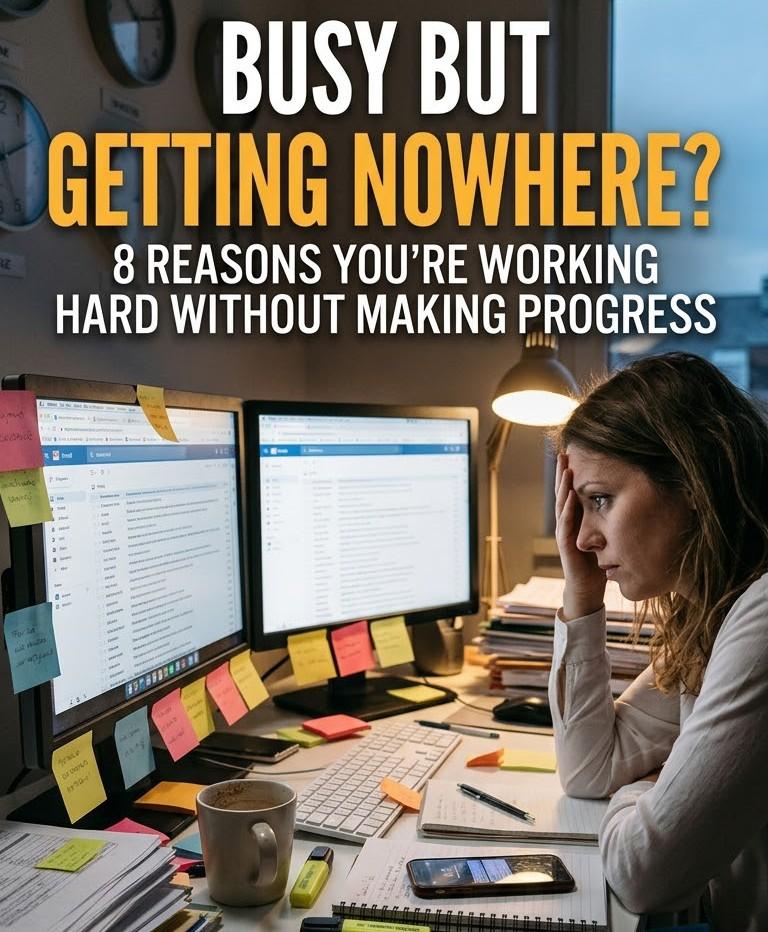
Have you ever reached the end of a long day feeling completely exhausted, yet struggled to identify anything meaningful you had accomplished?
Perhaps you spent hours answering messages, attending to different responsibilities, checking your phone, and moving between tasks. You were busy from morning until evening, but the important things you wanted to achieve remained unfinished.
This can be frustrating, especially when you are genuinely trying to improve your life.
The problem is that being busy and making progress are not always the same thing.
Busyness describes how much activity fills your day. Progress describes whether your actions are helping you move towards a meaningful goal.
You can spend hours working without addressing the problem that matters most. You can also make significant progress through a few carefully chosen actions.
If you often feel busy but unsatisfied with your results, understanding the reasons behind this pattern can help you work more effectively.
1. You're Doing Too Many Things at Once
One reason people struggle to make progress is that they attempt to handle too many responsibilities simultaneously.
You might want to learn a new skill, start a business, improve your health, build an online audience, read more books, and increase your income, all at the same time.
Each goal may be worthwhile. The difficulty comes from trying to give everything equal attention.
When your attention is constantly divided, it becomes harder to concentrate deeply on individual tasks. You may begin several projects but struggle to finish any of them.
Instead of trying to make progress everywhere at once, identify the goals that matter most during your current stage of life.
Ask yourself which one would make the greatest practical difference if you gave it consistent attention over the next few months.
You do not necessarily have to abandon your other ambitions. You can place some on hold while concentrating on the most important priority.
Focus does not mean that you have only one goal. It means that you understand which goal deserves your attention first.
2. You're Confusing Planning With Action
Planning is useful. It helps you understand what you want to achieve, identify possible obstacles, and decide what to do next.
However, planning can become a form of procrastination when it repeatedly replaces action.
Someone who wants to start a business might spend weeks choosing a name, designing a logo, researching competitors, and creating elaborate plans without speaking to a potential customer.
A person who wants to become a writer might spend more time organising writing tools than actually writing.
These activities may feel productive because they are related to the goal. Yet they do not always address the most important work.
To avoid this problem, connect every planning session to a concrete action.
If you spend an hour planning a project, identify something you can complete immediately afterwards.
That action might be writing the first paragraph, contacting a potential customer, publishing a useful page, or practising a new skill.
You do not need a perfect plan before beginning. Often, taking action reveals information that planning alone cannot provide.
3. You're Constantly Distracted
Modern technology makes information and entertainment available almost everywhere.
A notification appears while you are working. You check a message and discover another interesting post. One short video leads to several more.
Before you realise what has happened, a significant portion of your available time has disappeared.
The challenge is not that every distraction is harmful. Messages, entertainment, and social interaction have their place in everyday life.
The problem occurs when distractions repeatedly interrupt tasks that require concentration.
Frequent interruptions can make it difficult to maintain your train of thought, remember where you stopped, and complete demanding work efficiently.
Try creating a simple environment that supports concentration.
Put your phone away when it is not needed for the task. Silence non-essential notifications. Close unnecessary browser tabs. Choose a specific period for checking messages rather than responding to every alert immediately.
If you work online and need your phone or computer, decide which applications are necessary before beginning.
You do not have to eliminate entertainment from your life. You simply need to make sure it does not consume the time you intended to use for something important.
4. You Have Not Defined What Success Looks Like
It is difficult to measure progress when you have not decided what you are trying to accomplish.
For example, saying that you want to become successful is an understandable ambition, but it does not tell you what to do today.
Success might mean earning a particular income, learning a professional skill, completing a qualification, improving your business, or becoming more financially stable.
Without a clearer target, you may spend your time responding to whatever feels urgent instead of working towards a specific result.
Try turning a general ambition into a practical goal.
Instead of saying, "I want to improve my writing," you could decide to complete and edit two useful articles each week.
Instead of saying, "I want to grow my business," you could focus on understanding customer needs, improving one service, or contacting a realistic number of potential customers.
Your goals should reflect your actual circumstances. They should be challenging enough to encourage progress without being so unrealistic that you abandon them.
Once you know what you want to achieve, it becomes easier to identify which activities deserve your time.
5. You're Waiting for Motivation
Motivation can make it easier to begin a task, particularly when you feel excited about a new idea.
However, motivation naturally changes.
Some mornings, you may feel energetic and ready to work. On other days, you may feel tired, discouraged, or uncertain about your abilities.
If your progress depends entirely on feeling motivated, your results may become inconsistent.
One way to address this is to create routines that make important tasks easier to begin.
For example, if you want to practise a skill, choose a regular time and prepare the materials you need beforehand.
If you want to write consistently, decide on a manageable writing target rather than waiting for inspiration.
You can also make the first step very small. Instead of promising to work on a difficult project for three hours, commit to spending ten minutes getting started.
Beginning often makes the next step easier to approach.
However, discipline does not mean ignoring exhaustion or pushing yourself beyond reasonable limits. Rest is part of maintaining a sustainable routine.
The aim is to create a system that supports your goals even when your enthusiasm fluctuates.
6. You're Afraid of Making Mistakes
Sometimes people remain busy with small tasks because they are avoiding a larger task that feels uncomfortable.
You might organise your workspace repeatedly because you are nervous about submitting your work.
You might continue researching a business idea because you are afraid of discovering that customers are not interested.
You might keep editing a project because publishing it means allowing other people to judge the result.
This pattern can be difficult to recognise because the activities themselves may be useful. The problem is that they become ways to postpone an important decision or action.
Ask yourself whether you are doing something because it genuinely needs to be done or because it feels safer than the task you are avoiding.
If fear is holding you back, break the difficult task into smaller steps.
You could share a draft with one trusted person before publishing it widely. You could test a business idea with a small group of potential customers before investing heavily. You could apply for an opportunity even if you are unsure about the outcome.
You cannot guarantee that every attempt will succeed. But you can learn from the results and improve your next decision.
7. You're Measuring Effort Instead of Results
Working hard deserves recognition, but effort alone does not always tell you whether your approach is effective.
Imagine someone who spends several hours each day promoting a service but receives very few enquiries.
Simply increasing the number of hours spent promoting it may not solve the problem. The person may need to reconsider the target audience, improve the offer, clarify the message, or choose a more suitable marketing channel.
Similarly, someone studying for an examination may spend hours rereading notes without checking whether they can remember or apply the information.
In both cases, the issue is not necessarily a lack of effort. It may be a lack of feedback about what is working.
Choose a way to evaluate your results.
If you are learning, test your understanding with practice questions or projects.
If you are building a business, track meaningful indicators such as enquiries, completed sales, customer feedback, and repeat purchases.
If you are trying to improve your writing, assess whether your work answers readers' questions clearly and whether you are improving through editing and feedback.
The right measures depend on your goal.
Reviewing results helps you decide whether to continue your current approach or make a change.
8. You're Ignoring the Importance of Rest
Some people believe that making progress requires being productive every waking hour.
They fill their schedules with responsibilities, feel guilty when they rest, and treat exhaustion as evidence that they are working hard enough.
Over time, this approach can become difficult to sustain.
Insufficient rest can affect concentration, mood, decision-making, and your ability to manage everyday responsibilities.
When you are exhausted, even simple tasks may require more effort than usual. You may also find it harder to recognise problems or think creatively about possible solutions.
Rest is not necessarily wasted time.
Sleep, breaks, recreation, and time spent with people you care about can help you maintain your ability to work consistently.
This does not mean avoiding difficult responsibilities whenever you feel uncomfortable. It means recognising that your energy and attention are limited resources.
Build reasonable breaks into your routine. Protect your sleep where possible. If you are consistently exhausted, examine whether your workload is realistic and whether you need additional support.
Sustainable progress is usually more useful than an intense period of activity followed by complete burnout.
How to Make More Progress Without Working Every Hour
You do not need to reorganise your entire life overnight.
Start by using a simple daily system.
Step 1: Choose Your Most Important Task
At the beginning of the day, identify the task that would make the greatest difference to your current priorities.
It might be completing a work assignment, studying a difficult topic, improving your business, or resolving an important personal responsibility.
Write it down so that it does not disappear among smaller tasks.
Step 2: Break It Into Manageable Steps
Large tasks can feel overwhelming because they require many decisions.
Divide the task into smaller actions that you can complete one at a time.
For example, rather than writing "finish website" on your list, identify the next concrete step, such as completing the homepage text or testing a particular feature.
Step 3: Give It Your Attention
Choose a period when you are reasonably alert and reduce avoidable distractions.
You might work for 25 minutes and take a short break, or use a longer session if that suits your task.
The exact duration is less important than creating a period in which you can concentrate.
Step 4: Complete One Meaningful Action Before Adding More
New tasks will appear throughout the day. Some will be urgent, and others can wait.
Before switching to another activity, ask whether you can finish or meaningfully advance the task already in progress.
Of course, emergencies and genuine deadlines may require you to change direction. The goal is to avoid changing tasks simply because something new has attracted your attention.
Step 5: Review Your Day
At the end of the day, ask yourself three questions:
- What meaningful progress did I make?
- What prevented me from completing my most important task?
- What is the next step I should take tomorrow?
Use your answers to adjust your routine rather than criticising yourself for every unfinished item.
A daily review can help you recognise patterns and make better decisions about how you use your time.
Final Thoughts
Feeling busy but making little progress can be discouraging, particularly when you have important goals and responsibilities.
However, the solution is not always to work longer hours.
Sometimes you need to reduce distractions, concentrate on fewer priorities, stop overplanning, develop a more effective strategy, or give yourself enough rest to function well.
Start by identifying where your time and attention are going. Decide what matters most, take a practical step towards it, and review your results regularly.
You will still have days when unexpected responsibilities interrupt your plans. You will sometimes make mistakes or discover that your approach needs to change.
That is normal.
The important thing is to make sure that your everyday activities are connected to the life you are trying to build.
Being busy fills your time. Being intentional helps you decide what that time is for.
What Do You Think?
What is the biggest obstacle to your productivity: distractions, procrastination, too many responsibilities, fear of failure, or something else?
Share your experience in the comments. Your answer may help another reader discover a better way to manage their time.

Leave a comment
Your email address will not be published. Required fields are marked *