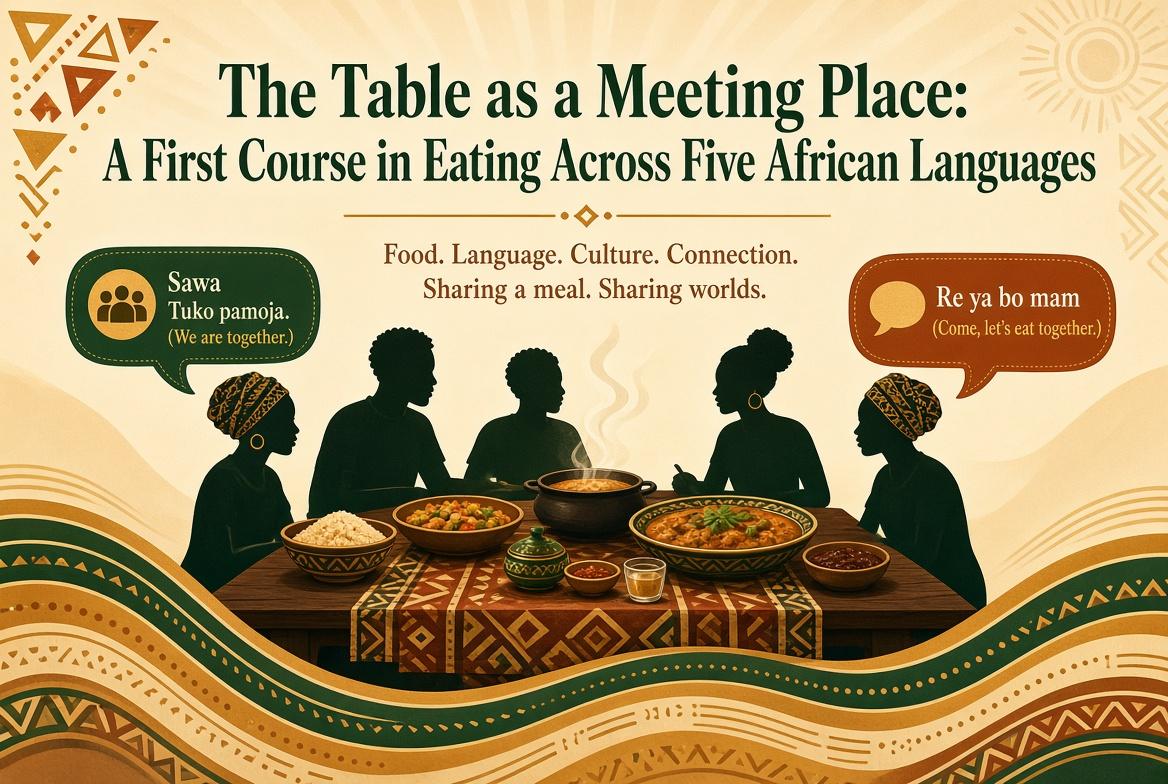
There is a moment before every meal when the world pauses. Hands are washed. Plates are set. The food is brought out, steaming and fragrant, and for a moment, everyone simply looks at it. Then someone says, "Come, let us eat." And the day begins.
Eating is one of the most human things we do. It is also one of the most cultural. How we eat, when we eat, what we eat, and with whom—all of these are shaped by traditions older than any of us. In many parts of Africa, eating is not a private act. It is a communal one. You do not eat alone if you can help it. You eat with family, with friends, with guests, with anyone who happens to be nearby. The plate is shared. The hands are used. The conversation flows.
This course is about that experience. We are going to explore fifty questions and answers about eating across five languages: Swahili, Oromo, Amharic, Fulani, and Lingala. These are the phrases you use when you sit down at the table, when you want to know what is being served, and when you want to express the deep pleasure of a good meal.
Let us begin with a truth: in Amharic, there is a word, gursha. It means the act of feeding someone by hand, placing a choice morsel directly into their mouth. It is a gesture of affection, of intimacy, of care. You do not gursha a stranger. You gursha someone you love. This is what eating means in many African cultures. It is not just nourishment. It is a love language.
So as we go through these fifty questions, think of them as an invitation. Each one is a way of saying, “Sit down. You are welcome here. Let us eat together.”
---
The Fifty Questions and Answers
Below are fifty questions and answers about eating, organized by topic. Not every language has a direct translation for every phrase, but these are the ones that travel best. Learn them in the language you are studying, or learn a few in each. The goal is not perfection. The goal is connection.
Inviting Someone to Eat
# English Swahili Oromo Amharic Fulani Lingala
1 Come and eat Njoo ule Koottu nyaadhu Na inbla Waraa nyaamu Yaka olia
2 Let us eat Twende tukale Haa nyaannu Inbil Ndeen nyaamdu Tokolia
3 Food is ready Chakula kiko tayari Nyaati qophaa'eera Migib tedegag new Nyamdu heblinaama Bilia ebongisami
4 Have you eaten? Umekula? Nyaattee? Biltaleh? A nyaamii? Olieki?
5 I have eaten Nimekula Nyaadhe Bilehu Mi nyaamii Nalieki
6 I have not eaten Sijakula Hin nyaanne Albilhum Mi nyaamaani Nalieki te
7 Please eat Tafadhali kula Maaloo nyaadhu Be'istu bli Achu nyaamu Loba lia
8 Eat well Kula vizuri Gaarii nyaadhu T'iru bli Nyaamu moƴƴum Lia malamu
9 Enjoy your meal Furahia chakula chako Nyaata kee itti fayyadami Migibih yit'afach Nyaamu ma weltaare Sepela na bilia na yo
10 Thank you for the food Asante kwa chakula Nyaataaf galatoomi Migibih ameseginalow Jaraama nyamdu Matondi mpo na bilia
Asking About Food
# English Swahili Oromo Amharic Fulani Lingala
11 What is this? Hii ni nini? Kun maali? Yih min new? Ndee ɗum ko? Yango ezali nini?
12 What is this called? Hii inaitwaje? Kun maal jedhama? Yih min yibalal? Ndee ɗum noddete? Yango ebengami nini?
13 What is in this dish? Kuna nini kwenye chakula hiki? Nyaata kana keessatti maal jira? Yih migib min al? Ndee nyamdu ko woni? Nini ezali na bilia oyo?
14 Is this spicy? Hii ina pilipili? Kun barbaree qabaa? Yih qmemama? Ndee ɗum nduɗndum? Yango ezali na pili-pili?
15 Is this sweet? Hii ni tamu? Kun mi'aawaa? Yih t'afach new? Ndee ɗum welndeendum? Yango ezali sukali?
16 Is this salty? Hii ina chumvi? Kun soogidda qabaa? Yih t'emem new? Ndee ɗum lamɗam? Yango ezali mongwa?
17 Is this meat? Hii ni nyama? Kun foon? Yih siga new? Ndee ɗum kusel? Yango ezali nyama?
18 Is this vegetarian? Hii haina nyama? Kun foon hin qabu? Yih siga yellem? Ndee ɗum alaa kusel? Yango ezali na nyama te?
19 What do you recommend? Unapendekeza nini? Maal gorsita? Min timeligal? Ko wasiyi ma? Olingi nini?
20 What is your favorite food? Chakula unachopenda ni kipi? Nyaata jaallattu maali? Yemeweded migib min new? Ndee nyamdu a yiɗi? Bilia olingi nini?
Talking About Taste
# English Swahili Oromo Amharic Fulani Lingala
21 This is delicious Hii ni tamu sana Kun baay'ee mi'aawaa Yih betam t'afach new Ndee ɗum welndeendum sanne Yango ezali kitoko mingi
22 This is good Hii ni nzuri Kun gaarii Yih t'iru new Ndee ɗum moƴƴum Yango ezali malamu
23 This is not good Hii si nzuri Kun hin gaarii Yih t'iru aydelem Ndee ɗum moƴƴaani Yango ezali malamu te
24 I like it Naipenda Nan jaaladha Ewedalehu Mi yidi ɗum Nalingi yango
25 I do not like it Siipendi Hin jaaladhu Alwedem Mi yiɗaa ɗum Nalingi yango te
26 It is too hot Ni moto sana Baay'ee ho'a Betam muk new Ndiyam sanne Ezali molunge mingi
27 It is too cold Ni baridi sana Baay'ee qorra Betam qez new Ɓuuɓri sanne Ezali malili mingi
28 It is too spicy Ina pilipili nyingi Barbaree baay'ee qaba Betam qmemama Nduɗndum sanne Ezali pili-pili mingi
29 It is perfect Ni kamili Sirrii dha T'iru new Ko moƴƴum Ezali malamu mpenza
30 I am full Nimeshiba Nan quufe T'egbu Mi heewii Natondi
At the Table
# English Swahili Oromo Amharic Fulani Lingala
31 Please sit at the table Tafadhali keti mezani Maaloo minjaala taa'i Be'istu t'erpeza t'ek'emi Achu joodo e teebal Loba vanda na mesa
32 Pass me the water Nipatie maji Bishaan naaf kenni Wuha sit'ign Hokku lam ndiyam Pesa ngai mai
33 Pass me the salt Nipatie chumvi Soogidda naaf kenni T'emem sit'ign Hokku lam lamɗam Pesa ngai mongwa
34 Can I have more? Naweza kupata zaidi? Dabalata argachuu danda'aa? T'emari agignaleh? Mi mbaawi ɓeydude? Nakoki kozwa lisusu?
35 Please have more Tafadhali ongeza Maaloo dabaladhu Be'istu t'emari Achu ɓeydu Loba zwa lisusu
36 I cannot eat anymore Siwezi kula tena Dabalataan nyaachuu hin danda'u T'emari albelam Mi waawi nyaamde kadi Nakoki kolia lisusu te
37 The food is wonderful Chakula ni cha ajabu Nyaati ajaa'iba Migib aja'ib new Nyamdu ko haawniiɗum Bilia ezali kitoko
38 Who cooked this? Nani alipika hii? Kana eenyu bilcheesse? Yih man at'enew? Ndee ko waɗi ɗum? Nani atumbaki yango?
39 You are a good cook Wewe ni mpishi mzuri Ati bilcheessaa gaarii T'iru at'enyi neh A defoowo moƴƴo Ozali motumbi malamu
40 Let us give thanks Tushukuru Galatoomaa haa kennu Inamesgin Ndeen yette Tokofuta matondi
Food and Culture
# English Swahili Oromo Amharic Fulani Lingala
41 What is your traditional food? Chakula chako cha jadi ni kipi? Nyaata aadaa kee maali? Bahlawi migibih min new? Ndee nyamdu aada ma? Bilia ya bonkoko na yo nini?
42 This is our traditional food Hiki ni chakula chetu cha jadi Kun nyaata aadaa keenya Yih bahlawi migibachin new Ndee ko nyamdu aada amen Oyo ezali bilia ya bonkoko na biso
43 How do you prepare this? Unaandaa hii vipi? Kana akkam qopheessita? Yih endet tazegajal? Ndee ɗum no heblirtee? Yango ebongisami ndenge nini?
44 Do you eat with your hands? Unakula kwa mikono? Harkaan nyaatta? Be'ijih tinblal? A nyaamda e juu? Oliaka na maboko?
45 Do you use utensils? Unatumia vifaa vya kula? Meeshaa nyaataa fayyadamta? Ye migib mezwed titegnal? A huutortaa kuɓe? Osalelaka bisaleli?
46 Food brings people together Chakula huleta watu pamoja Nyaati namoota walitti fida Migib sewwochun yasabsegal Nyamdu no seɗɗinta yimɓe Bilia esangisaka bato
47 We eat together as a family Tunakula pamoja kama familia Maatii taanee waliin nyaanna Ande beteseb hona inbil Min nyaamda e ɓesngu Tolia elongo lokola libota
48 Sharing food is sharing love Kugawana chakula ni kugawana upendo Nyaata qooduun jaalala qooduudha Migib mekakel fik'ir mekakel new Seɗɗitde nyamdu ko seɗɗitde yiɗde Kokabola bilia ezali kokabola bolingo
49 A full stomach is a happy heart Tumbo lililojaa ni moyo wenye furaha Garaan quufaa onnee gammachuu Yet'egbe hod motema t'irign Reedu heewndu ɓernde weltaare Libumu ya matiti ezali motema ya esengo
50 Thank you for this meal Asante kwa chakula hiki Nyaata kanaaf galatoomi Yih migib ameseginalow Jaraama nyamdu ndu Matondi mpo na bilia oyo
---
The Grammar of Eating
The grammar of eating is the grammar of sharing. It is about giving and receiving.
In Swahili, the verb kula means "to eat." It is a simple verb, but it carries a world of meaning. Twende tukale means "Let us go and eat." The verb is in the subjunctive mood, which expresses a wish or an invitation. It is not a command. It is a suggestion. It is a way of saying, “I want to share this with you.”
In Oromo, the verb nyaachuu means "to eat." Haa nyaannu means "Let us eat." The word haa is a particle that expresses a wish. It is like saying, "May we eat." It is a blessing.
In Amharic, the verb meblat means "to eat." Inbil means "Let us eat." The verb is in the imperative form, but it is softened by the context. It is not a command. It is an invitation.
In Fulani, the verb nyaamde means "to eat." Ndeen nyaamdu means "Let us eat." The word ndeen is a particle that expresses a suggestion. It is a way of saying, “Come, let us eat together.”
In Lingala, the verb kolia means "to eat." Tokolia means "Let us eat." The word to- is the subject prefix for "we." The verb is simple and direct. It is a call to the table.
---
How to Practice Eating Language
You cannot learn eating language from a book. You learn it by eating.
Cook a meal. Find a recipe from one of these cultures. Cook it. As you cook, say the words for the ingredients in the language you are studying.
Eat with your hands. In many African cultures, food is eaten with the right hand. Try it. Notice how it changes the experience. Say the phrases for "delicious" and “I am full.”
Share a plate. In many cultures, food is served on a communal plate. Sit with friends. Share the food. Say Karibu. Baga nagaan dhuftu. Enkuan dehin. Biseno. Boyei malamu.
Give thanks. Before you eat, say thank you in the language you are studying. Asante. Galatoomi. Ameseginalow. Jaraama. Matondi.
Learn the names of foods. Learn how to say rice, beans, meat, vegetables, fruit, water, tea, coffee. These are the words you will use every day.
---
The Fifty-First Question
There is one question that is not on the list. It is the question you ask yourself when you have learned all fifty phrases: Who will I eat with?
Eating is not just about food. It is about community. It is about sitting down with people and sharing something. It is about the conversation, the laughter, the silence. It is about the moment when someone reaches across the table and places a morsel in your mouth—the gursha—and you know that you are loved.
So learn these phrases. Use them. But remember that the most important thing you can bring to a meal is not a dish. It is yourself. It is your presence. It is your willingness to sit down and be part of the family.
And that willingness needs no translation.
It is called belonging.

Leave a comment
Your email address will not be published. Required fields are marked *