There is a moment in every friendship when the conversation moves past the surface. You have asked about family. You have asked about work. And then comes the question that opens a different door: What do you love to do?
The answer to that question tells you who a person really is. Not their job. Not their obligations. Their interests. The things they do when no one is watching. The things that make their eyes light up. The things that make them lose track of time.
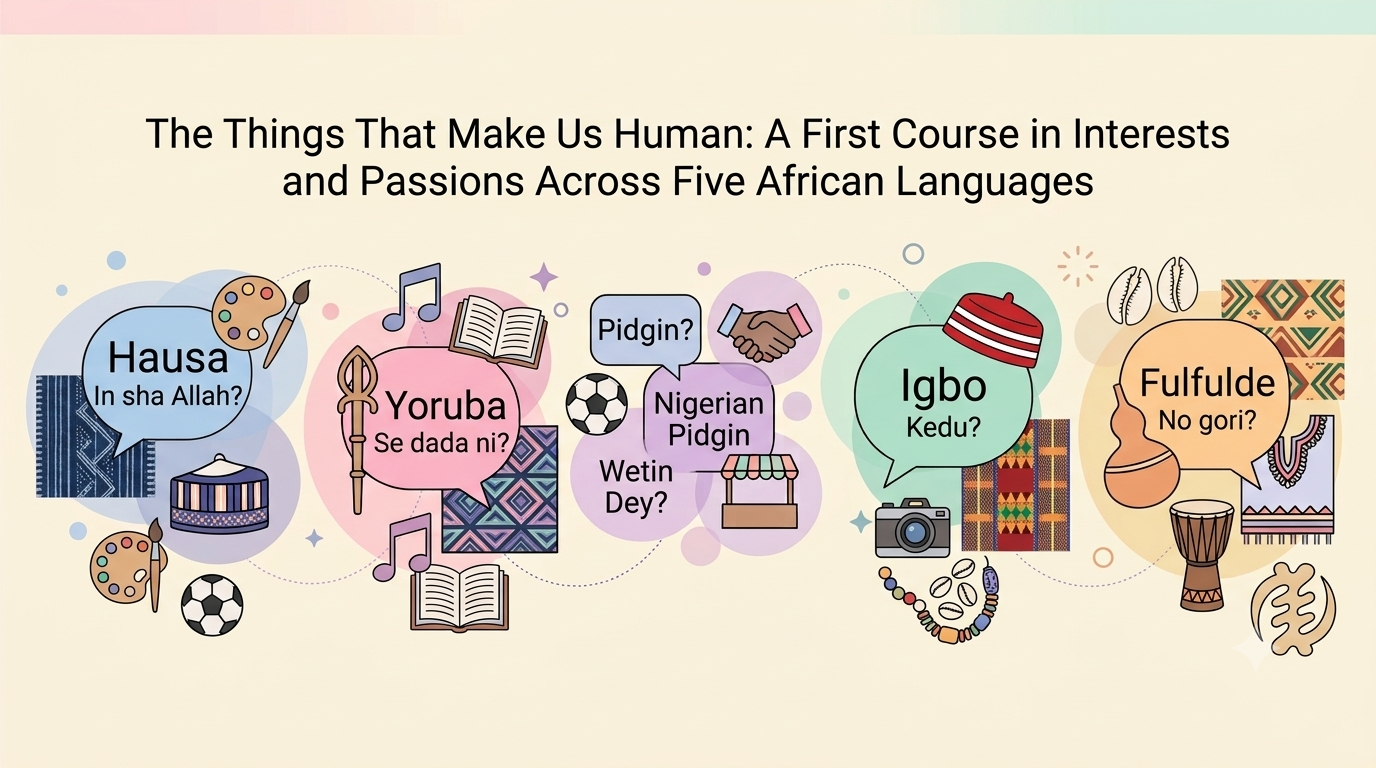
This course is about those things. We are going to explore fifty questions and answers about interests and passions across five languages: Swahili, Oromo, Amharic, Fulani, and Lingala. These are the phrases you use when you want to know what makes someone tick. They are the questions that turn acquaintances into friends.
Let us begin with a truth: in many African cultures, interests are not separate from life. They are woven into it. A man who plays the kora is not just a musician. He is a keeper of history. A woman who weaves baskets is not just a craftsperson. She is a teacher of tradition. A child who plays football is not just having fun. He is learning teamwork, discipline, and joy.
In Swahili, there is a word, shauku. It means passion, enthusiasm, a burning interest. In Oromo, fedhii means desire or interest. In Amharic, fikir means love or affection. In Fulani, yiɗde means to love, to want, to be drawn toward something. In Lingala, kolinga means to love, to like, to enjoy.
These words are not just vocabulary. They are doors. They are invitations. They are ways of saying, “Tell me what you love. Tell me who you are.”
---
The Fifty Questions and Answers
Below are fifty questions and answers about interests and passions, organized by topic. Not every language has a direct translation for every phrase, but these are the ones that travel best. Learn them in the language you are studying, or learn a few in each. The goal is not perfection. The goal is connection.
Asking About Interests
# English Swahili Oromo Amharic Fulani Lingala
1 What do you like to do? Unapenda kufanya nini? Maal gochuu jaallatta? Min madreg? Ko yiɗɗaa waɗde? Olingi kosala nini?
2 What are your hobbies? Una shughuli gani za burudani? Maal gochuu jaallatta? Min madreg? Ko yiɗɗaa waɗde? Olingi kosala nini?
3 What do you do for fun? Unafanya nini kwa starehe? Bashannanaaf maal hojjatta? Mezineb min tiseraleh? Ko waɗdataa weltaare? Osalaka nini mpo na esengo?
4 What are you interested in? Unavutiwa na nini? Maalitti hawwatta? Min yasasiqal? Ko weltaa ma? Nini epekisaka yo?
5 What do you enjoy? Unafurahia nini? Maal kee gammachiisa? Min t'irih yadergal? Ko weltinta? Nini esepelisaka yo?
6 Do you have a hobby? Una hobby? Hobby qabdaa? Hobby aleh? Aɗa hobby? Ozali na hobby?
7 I like to read Napenda kusoma Dubbisuu nan jaaladha Manbeb alehu Mi yidi janngude Nalingi kotanga
8 I like to write Napenda kuandika Barreessuu nan jaaladha Mit'af alehu Mi yidi winndude Nalingi kokoma
9 I like to draw Napenda kuchora Suuraa kaasuu nan jaaladha Mesrat alehu Mi yidi natalde Nalingi kosala misala
10 I like to cook Napenda kupika Bilcheessuu nan jaaladha Mat'en alehu Mi yidi defde Nalingi kotumba
Music and Art
# English Swahili Oromo Amharic Fulani Lingala
11 Do you like music? Unapenda muziki? Muuziqaa jaallatta? Mizika ewedaleh? A yiɗi muusik? Olingi miziki?
12 What kind of music do you like? Unapenda muziki wa aina gani? Muuziqaa akkam jaallatta? Yih mizika min wedaleh? Ndee muusik a yiɗi? Olingi miziki nini?
13 I like traditional music Napenda muziki wa kitamaduni Muuziqaa aadaa jaaladha Bahlawi mizika ewedalehu Mi yidi muusik aada Nalingi miziki ya bonkoko
14 I like modern music Napenda muziki wa kisasa Muuziqaa ammayyaa jaaladha Zemenawi mizika ewedalehu Mi yidi muusik hannde Nalingi miziki ya sikoyo
15 Can you sing? Unaweza kuimba? Weeddaluu dandeessa? Mezmur tichilaleh? A mbaawi yimeede? Okoki koyemba?
16 Can you play an instrument? Unaweza kupiga ala? Meeshaa muuziqaa rukutuu dandeessa? Mezika mezwed tichilaleh? A mbaawi buggude kuɓal? Okoki kobeta instrument?
17 I play the guitar Ninapiga gitaa Gitaarii nan rukuta Gitar enwetalehu Mi buggata gitaar Nabeta gita
18 I play the drums Ninapiga ngoma Dibbee nan rukuta Kebero enwetalehu Mi buggata calɗi Nabeta ngoma
19 Do you like to dance? Unapenda kucheza? Shuubbuu jaallatta? Wist t'ewataleh? A yiɗi dillude? Olingi kobina?
20 I love to dance Napenda kucheza sana Shuubbuu baay'ee jaaladha Wist betam ewedalehu Mi yidi dillude sanne Nalingi kobina mingi
Sports and Games
# English Swahili Oromo Amharic Fulani Lingala
21 Do you like sports? Unapenda michezo? Ispoortii jaallatta? Sport ewedaleh? A yiɗi sport? Olingi sport?
22 What sport do you play? Unacheza mchezo gani? Ispoortii akkam taphatta? Yih sport t'ewataleh? Ndee sport a fijiraa? Osalaka sport nini?
23 I play football Ninacheza mpira Kubbaa miilaa nan taphadha Kubbaa t'ewatalehu Mi fijira ball Nasalaka football
24 I play basketball Ninacheza mpira wa kikapu Kubbaa kappee nan taphadha Basketiball t'ewatalehu Mi fijira basketball Nasalaka basketball
25 I like running Napenda kukimbia Fiiguu nan jaaladha Riggat ewedalehu Mi yidi doggude Nalingi kopota
26 I like swimming Napenda kuogelea Dhiqaa nan jaaladha Winet ewedalehu Mi yidi lootde Nalingi kopepa
27 Do you watch sports? Unatazama michezo? Ispoortii ilaalla? Sport tinataleh? A ndaaraa sport? Olingi kotala sport?
28 Who is your favorite team? Timu yako unayopenda ni ipi? Garee jaallattu eenyu? Yemeweded team min new? Ndee team a yiɗi? Equipe olingi nani?
29 I like to play cards Napenda kucheza karata Kaardii tapachuu nan jaaladha Karta t'ewat ewedalehu Mi yidi fijude kaɗe Nalingi kosala carte
30 I like board games Napenda michezo ya bodi Tapha gabatee jaaladha Board game ewedalehu Mi yidi fijude board Nalingi kosala jeu
Travel and Adventure
# English Swahili Oromo Amharic Fulani Lingala
31 Do you like to travel? Unapenda kusafiri? Imaluu jaallatta? Mewededaleh? A yiɗi yahde? Olingi kokende?
32 Where have you traveled? Umesafiri wapi? Eessa imalte? Yet tewaledk? Toy yahiiɗaa? Okendaki wapi?
33 I want to visit your country Nataka kutembelea nchi yako Biyya ke daawwachuu barbaada Hagerih bit'emagnalehu Mi yiɗi yillaade leydi ma Nalingi kokende na mboka na yo
34 I love the mountains Napenda milima Gaarreen nan jaaladha Gara ewedalehu Mi yidi pelle Nalingi bangomba
35 I love the ocean Napenda bahari Galaana nan jaaladha Bahir ewedalehu Mi yidi maayo Nalingi mbu
36 I love the city Napenda mji Magaalaa nan jaaladha Ketema ewedalehu Mi yidi saare Nalingi engumba
37 I love the village Napenda kijiji Baadiyyaa nan jaaladha Yegara ketema ewedalehu Mi yidi ladde Nalingi mboka
38 Do you like camping? Unapenda kupiga kambi? Camping jaallatta? Camping ewedaleh? A yiɗi camp? Olingi kokende na camp?
39 I like adventure Napenda vituko Bashannana jaaladha Adventure ewedalehu Mi yidi jahaale Nalingi mobembo
40 Travel opens the mind Kusafiri hufungua akili Imalli sammu bana Meweded be'ir yikifet'al Jahaale uddita hakkil Mobembo efungolaka makanisi
Food and Cooking
# English Swahili Oromo Amharic Fulani Lingala
41 Do you like to cook? Unapenda kupika? Bilcheessuu jaallatta? Mat'en ewedaleh? A yiɗi defde? Olingi kotumba?
42 What is your favorite food? Chakula unachopenda ni kipi? Nyaata jaallattu maali? Yemeweded migib min new? Ndee nyamdu a yiɗi? Bilia olingi nini?
43 I love African food Napenda chakula cha Kiafrika Nyaata Afrikaa nan jaaladha YeAfrika migib ewedalehu Mi yidi nyamdu Afrik Nalingi bilia ya Afrika
44 Can you cook? Unaweza kupika? Bilcheessuu dandeessa? Mat'en tichilaleh? A mbaawi defde? Okoki kotumba?
45 I can cook Naweza kupika Bilcheessuu nan danda'a Mat'en ichilalehu Mi mbaawi defde Nakoki kotumba
46 What do you like to eat? Unapenda kula nini? Maal nyaachuu jaallatta? Min meblat tedaleh? Ko yiɗɗaa nyaame? Olingi kolia nini?
47 I like spicy food Napenda chakula cha pilipili Nyaata barbaree jaaladha Qmemama migib ewedalehu Mi yidi nyamdu nduɗndu Nalingi bilia ya pili-pili
48 I like sweet food Napenda chakula kitamu Nyaata mi'aawaa jaaladha T'afach migib ewedalehu Mi yidi nyamdu welndeendu Nalingi bilia ya sukali
49 Food brings people together Chakula huleta watu pamoja Nyaati namoota walitti fida Migib sewwochun yasabsegal Nyamdu no seɗɗinta yimɓe Bilia esangisaka bato
50 Let us eat together Twende tukale pamoja Waliin haa nyaannu Ande inbil Ndeen nyaamdu Tokolia elongo
---
The Grammar of Passion
When you talk about interests in these languages, you notice something beautiful. The verbs are active. They are full of life.
In Swahili, the verb kupenda means "to love" or "to like." Napenda means "I love." It is a warm word. It is used for people, for food, for music, for life. When you say Napenda muziki, you are not just stating a preference. You are declaring a piece of yourself.
In Oromo, the verb jaaladha means "I love" or "I like." Nan jaaladha means "I love it." The word is rooted in jaalala, which means love. It is a deep word. It carries weight.
In Amharic, the verb ewedalehu means "I love" or "I like." It is used for people, for activities, for things. When you say Mizika ewedalehu, you are saying, “Music is dear to me.”
In Fulani, the verb yiɗi means "to love" or "to want." Mi yidi means "I love" or "I want." The word carries both desire and affection. It is a word of the heart.
In Lingala, the verb kalinga means "to love." Nalingi means "I love." It is used for people, for activities, for food. When you say Nalingi kosala football, you are saying, “Football is my joy.”
---
How to Practice Talking About Interests
You cannot learn to talk about interests without sharing your own.
Make a list of what you love. Write down ten things you love to do. Then learn how to say them in the language you are studying. Practice until they feel natural.
Ask others about their interests. When you meet someone, ask what they love to do. Listen to their answers. Ask follow-up questions. Show genuine curiosity.
Try new things. Language learning is not just about words. It is about experiences. If someone invites you to play football, say yes. If someone offers to teach you a song, say yes. The words will come.
Share your passions. Tell people about the things you love. Show them your photos. Play them your music. Invite them into your world. Language is a bridge, and bridges are built from both sides.
---
The Fifty-First Question
There is one question that is not on the list. It is the question you ask yourself when you have learned all fifty phrases: What do I love?
Interests are not trivial. They are not hobbies. They are the things that make life worth living. They are the things that connect us to each other. When you share your interests with someone, you are sharing a piece of your soul.
So learn these phrases. Use them. But remember that the most important thing you can do is not to speak perfectly. It is to listen with an open heart. It is to ask questions because you truly want to know. It is to say, “Tell me what you love. I want to know who you are.”
And that curiosity needs no translation.
It is called friendship.

Leave a comment
Your email address will not be published. Required fields are marked *