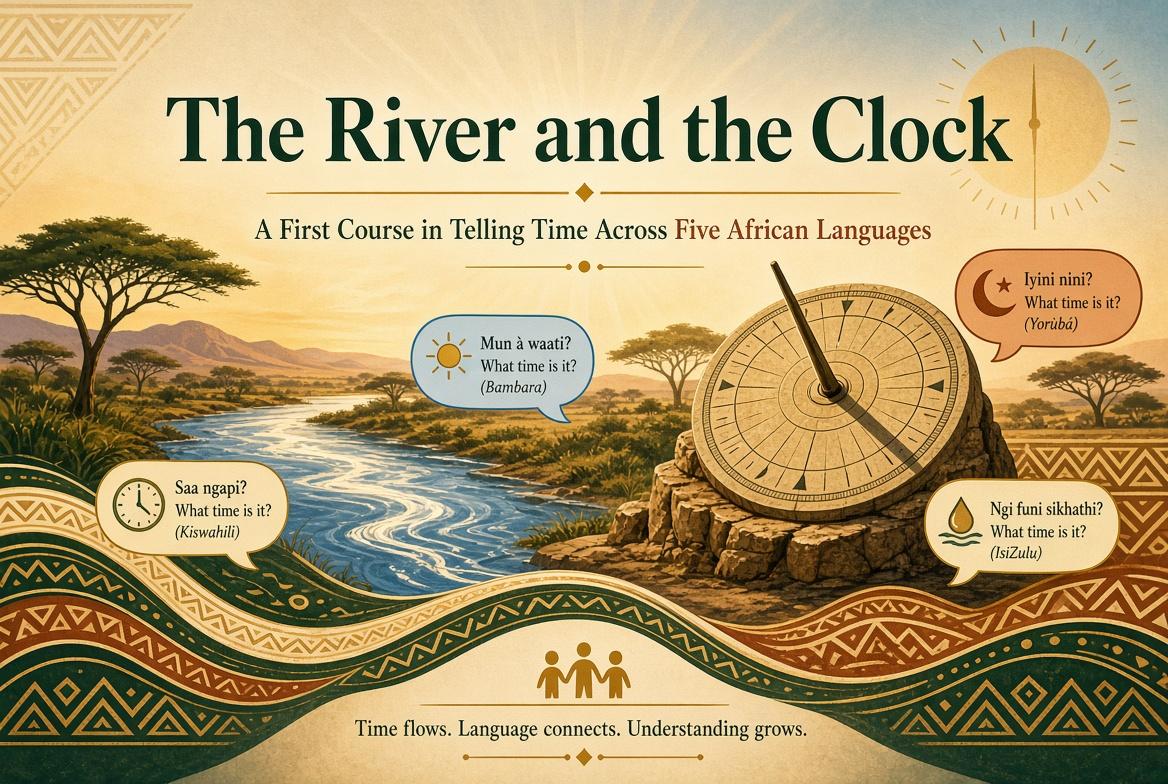
Time is one of the strangest things we talk about. We cannot see it. We cannot touch it. But we organize our entire lives around it. We wake at a certain time. We work at a certain time. We meet, we eat, we sleep, we dream—all according to the quiet ticking of a clock.
And yet, not every culture tells time the same way. In many parts of Africa, time is not a straight line. It is a circle. It is the sun rising and setting. It is the rainy season and the dry season. It is the rooster crowing and the market filling and the children coming home before dark. The clock is a recent invention. The rhythm of the day is ancient.
This course is about that rhythm. We are going to explore fifty questions and answers about telling time across five languages: Swahili, Oromo, Amharic, Fulani, and Lingala. These are the phrases you use when you want to know what time it is, when you want to say when something will happen, and when you want to understand how time moves in another culture.
Let us begin with a truth: in Swahili, the day does not begin at midnight. It begins at sunrise. Six in the morning is saa moja—one o'clock. Noon is saa sita—six o'clock. Six in the evening is saa kumi na mbili—twelve o'clock. This is not a mistake. It is a different way of counting. The Swahili day begins when the sun rises, because that is when life begins. This is the Swahili clock, and it runs on light, not numbers.
So as we go through these fifty questions, do not just memorize the phrases. Try to feel the rhythm. Time is not just a measurement. It is a way of being.
---
The Fifty Questions and Answers
Below are fifty questions and answers about telling time, organized by topic. Not every language has a direct translation for every phrase, but these are the ones that travel best. Learn them in the language you are studying, or learn a few in each. The goal is not perfection. The goal is understanding.
Asking for the Time
# English Swahili Oromo Amharic Fulani Lingala
1 What time is it? Saa ngapi? Sa'aatii meeqa? Sint saat new? Ndee waktu? Ngonga nini?
2 Do you have the time? Una saa? Sa'aatii qabdaa? Sa'at aleh? Aɗa waktu? Ozali na ngonga?
3 Can you tell me the time? Unaweza kuniambia saa? Sa'aatii naaf himuu dandeessa? Sa'at lih yemilaleh? A mbaawi wiye lam waktu? Okoki koyebisa ngai ngonga?
4 It is one o'clock Ni saa moja Sa'aatii tokko And saat new Waktu gooto Ngonga moko
5 It is two o'clock Ni saa mbili Sa'aatii lama Hulet saat new Waktu ɗiɗi Ngonga mibale
6 It is three o'clock Ni saa tatu Sa'aatii sadii Sost saat new Waktu tati Ngonga misato
7 It is noon Ni saa sita mchana Waaree dha K'en new Waktu caka Midi
8 It is midnight Ni saa sita usiku Halkan walakkaa Lelit k'en new Waktu caka jemma Midi ya butu
9 It is morning Ni asubuhi Ganama T'ewat new Subaka Ntongo
10 It is evening Ni jioni Galgala Mishet new Kikiiɗe Mpokwa
Parts of the Day
# English Swahili Oromo Amharic Fulani Lingala
11 Morning Asubuhi Ganama T'ewat Subaka Ntongo
12 Afternoon Mchana Waaree K'en Caka Midi
13 Evening Jioni Galgala Mishet Kikiiɗe Mpokwa
14 Night Usiku Halkan Lelit Jemma Butu
15 Dawn Alfajiri Barii Neg Fajiri Ntongo ya ntongo
16 Dusk Machweo Galgala Mishet Kikiiɗe Mpokwa ya mpokwa
17 Early morning Asubuhi na mapema Ganama ganama T'ewat t'ewat Subaka subaka Ntongo na ntongo
18 Late at night Usiku sana Halkan halkan Lelit lelit Jemma jemma Butu na butu
19 All day Siku nzima Guyyaa guutuu K'en hulu Ñalnde fuu Mokolo mobimba
20 All night Usiku kucha Halkan guutuu Lelit hulu Jemma fuu Butu mobimba
Days of the Week
# English Swahili Oromo Amharic Fulani Lingala
21 Monday Jumatatu Wiixata Segno Altine Mokolo ya liboso
22 Tuesday Jumanne Qibxata Maksagno Talaata Mokolo ya mibale
23 Wednesday Jumatano Roobii Rebu Alarba Mokolo ya misato
24 Thursday Alhamisi Kamisa Hamus Alkamisa Mokolo ya minei
25 Friday Ijumaa Jimaata Arb Aljuma Mokolo ya mitano
26 Saturday Jumamosi Sanbata Kidame Asibit Mokolo ya mpokwa
27 Sunday Jumapili Dilbata Ihud Dimas Mokolo ya eyenga
28 Today Leo Har'a Zare Hannde Lelo
29 Tomorrow Kesho Boru Nege Jaŋngo Lobi
30 Yesterday Jana Kaleessa Tilant Haŋki Lobi ya kala
Talking About Duration
# English Swahili Oromo Amharic Fulani Lingala
31 How long? Muda gani? Yeroo meeqa? Sint gize? Ndee dumunnde? Ntango boni?
32 One hour Saa moja Sa'aatii tokko And saat Waktu gooto Ngonga moko
33 Two hours Saa mbili Sa'aatii lama Hulet saat Waktu ɗiɗi Ngonga mibale
34 One minute Dakika moja Daqiiqaa tokko And daqiqa Minit gooto Miniti moko
35 Five minutes Dakika tano Daqiiqaa shan Amist daqiqa Minit jowi Miniti mitano
36 A little while Muda kidogo Yeroo xiqqoo T'ik'it gize Seeɗa Moke
37 A long time Muda mrefu Yeroo dheeraa Bizu gize Dumunnde Ntango molai
38 Soon Hivi karibuni Dhiyootti T'ik'it Seeɗa Noki
39 Later Baadaye Booda Behwal Caggal Sima
40 Now Sasa Amma Ahun Jooni Sikoyo
Making Appointments and Schedules
# English Swahili Oromo Amharic Fulani Lingala
41 At what time? Kwa saa ngapi? Sa'aatii meeqa? Be sint saat? E ndee waktu? Na ngonga nini?
42 At three o'clock Saa tatu Sa'aatii sadii Be sost saat E waktu tati Na ngonga misato
43 At half past three Saa tatu na nusu Sa'aatii sadii walakkaa Be sost saat tefat E waktu tati e nder Na ngonga misato na ndambu
44 At quarter to four Saa tatu na robo Sa'aatii sadii roobii Be sost saat rubu E waktu tati e rubu Na ngonga misato na kwarti
45 In the morning Asubuhi Ganama Be t'ewat E subaka Na ntongo
46 In the afternoon Mchana Waaree Be k'en E caka Na midi
47 In the evening Jioni Galgala Be mishet E kikiiɗe Na mpokwa
48 At night Usiku Halkan Be lelit E jemma Na butu
49 I will be there at... Nitakuwa hapo saa... Sa'aatii...nan jira Be...alehu Mi woni ɗoo e... Nakozala kuna na…
50 The meeting is at... Mkutano ni saa... Walgahni sa'aatii... Mikir be...new Beta ko e... Libala ezali na…
---
The Grammar of Time
The grammar of time reveals how a culture thinks about time itself.
In Swahili, the day begins at sunrise. Six in the morning is saa moja—one o'clock. This is because the Swahili clock starts when the sun rises. The hours are counted from dawn, not from midnight. This is not a small detail. It is a philosophy. Time begins with light.
In Oromo, the word yeroo means time. It is a broad word. It can mean a moment, a season, an era. The Oromo people are traditionally pastoralists, and time is measured by the movement of animals, the coming of rain, the cycles of the moon. The clock is secondary.
In Amharic, the word gize means time. It is used in phrases like sint gize?—"what time?" The Amharic day, like the Swahili day, traditionally begins at sunrise. But modern Amharic also uses the Western clock. Both systems exist side by side.
In Fulani, the word waktu comes from Arabic. It means time, moment, hour. The Fulani are a nomadic people, and time is often measured by the sun and the stars. The clock is useful, but it is not the master.
In Lingala, the word ngonga means hour or time. It comes from the Lingala verb konga, which means to strike or to sound. Time is something that announces itself. It is not silent. It rings.
---
How to Practice Telling Time
You cannot learn to tell time in a new language without practicing.
Wear a watch. Look at it. Say the time out loud in the language you are studying. Do this ten times a day.
Use your phone. Change the language settings on your phone to Swahili or Amharic or Lingala. You will see the time in a new way.
Make a schedule. Write down your daily routine in the language you are studying. What time do you wake up? What time do you eat? What time do you sleep?
Listen to the radio. Many African radio stations announce the time in local languages. Listen and repeat.
Be patient with the Swahili clock. If you are used to the Western clock, the Swahili system will feel strange at first. But give it time. It will become natural.
---
The Fifty-First Question
There is one question that is not on the list. It is the question you ask yourself when you have learned all fifty phrases: What is time for?
Time is not just a measurement. It is a gift. It is the space we have to love, to work, to rest, to be with each other. In Swahili, there is a proverb: Muda ni fedha. Time is money. But in many African cultures, the proverb is incomplete. Yes, time is valuable. But it is not just money. It is life.
So learn these phrases. Use them. But remember that the most important thing you can do with time is not to count it. It is to fill it. It is to be present. It is to show up.
And that presence needs no translation.
It is called living.

Leave a comment
Your email address will not be published. Required fields are marked *