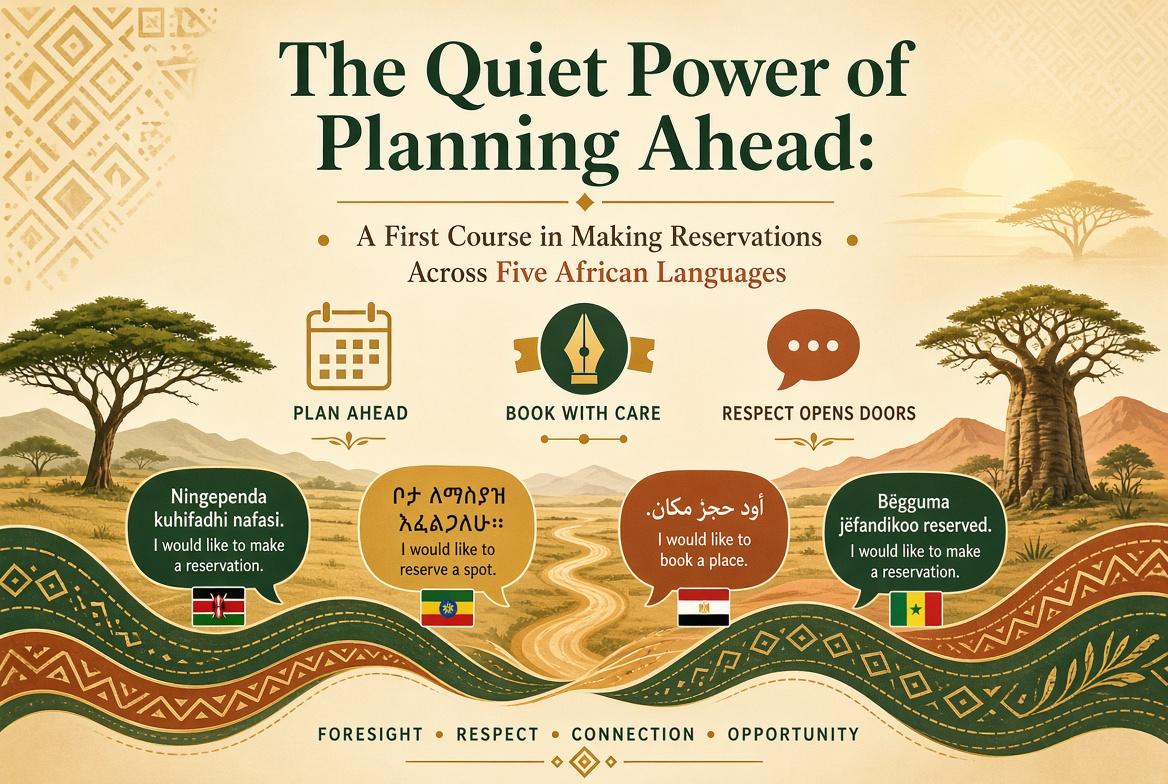
There is a certain kind of confidence that comes from planning ahead. You pick up the phone. You speak to a stranger. You say the words that secure your place—a table at a restaurant, a room at a hotel, a seat on a bus. It is a small act of organization, but it is also an act of faith. You are trusting that the future will arrive, and that you will be ready for it.
In many African cities, making a reservation is not always a formal affair. In some places, you simply show up and hope for the best. In others, a phone call is enough. But as cities grow and businesses modernize, the art of reserving has become more common. Restaurants in Nairobi take bookings. Hotels in Addis Ababa have reception desks. Bus companies in Kinshasa sell tickets in advance. And with this change comes a new vocabulary—words for confirming, cancelling, changing, and waiting.
This course is about that vocabulary. We are going to explore fifty questions and answers about making reservations across five languages: Swahili, Oromo, Amharic, Fulani, and Lingala. These are the phrases you use when you want to secure a table, book a room, or hold a seat. They are the words of planning, of preparation, of making sure that the future has a place for you.
Let us begin with a truth: in many African cultures, hospitality is not something you reserve. It is something you give. The guest does not need an appointment. The door is always open. But as the world changes, and as travel and business demand more structure, the reservation has become a necessary tool. It is not a rejection of hospitality. It is an extension of it. It is a way of saying, “I want to make sure you are taken care of.”
So as we go through these fifty questions, think of them as a bridge between two worlds. The world of spontaneity and the world of planning. Both have their place. Both have their words.
---
The Fifty Questions and Answers
Below are fifty questions and answers about making reservations, organized by topic. Not every language has a direct translation for every phrase, but these are the ones that travel best. Learn them in the language you are studying, or learn a few in each. The goal is not perfection. The goal is confidence.
Reserving a Table at a Restaurant
# English Swahili Oromo Amharic Fulani Lingala
1 I would like to reserve a table Ningependa kuweka meza Minjaala qopheessuu barbaada T'erpeza mayazegnalehu Mi yiɗi heblude teebal Nalingi kobomba mesa
2 A table for two, please Meza ya watu wawili, tafadhali Minjaala nama lamaaf, maaloo Lehulet sew t'erpeza, be'istu Teebal yimɓe ɗiɗo, achu Mesa mpo na bato mibale, loba
3 A table for four, please Meza ya watu wanne, tafadhali Minjaala nama afurii, maaloo Le'arat sew t'erpeza, be'istu Teebal yimɓe nayi, achu Mesa mpo na bato minei, loba
4 For tonight Kwa usiku wa leo Halkan har'aaf Lelelit zare Jemma hannde Mpo na butu ya lelo
5 For tomorrow evening Kwa jioni ya kesho Galgala boruuf Mishet nege Kikiiɗe jaŋngo Mpo na mpokwa ya lobi
6 At seven o'clock Saa moja usiku Sa'aatii torba Be sebat saat E waktu jeeɗiɗi Na ngonga nsambo
7 Under the name of... Kwa jina la... Maqaa... Be sim... E innde... Na nkombo…
8 My name is... Jina langu ni... Maqaan koo... Simeh... Innde am... Kombo na ngai…
9 Do you have a table available? Una meza tupu? Minjaala duwwaa qabduu? T'erpeza yelleh? Aɗa teebal ɓaɗtiiɗo? Ozali na mesa ya liboso?
10 Is there a table outside? Kuna meza nje? Minjaala ala jiraa? T'erpeza yewiT'al? Teebal boowal woni? Mesa ya libanda ezali?
Reserving a Room at a Hotel
# English Swahili Oromo Amharic Fulani Lingala
11 I would like to reserve a room Ningependa kuweka chumba Kutaa qopheessuu barbaada Kifil mayazegnalehu Mi yiɗi heblude suudu Nalingi kobomba shambre
12 A single room, please Chumba cha mtu mmoja, tafadhali Kutaa nama tokkoof, maaloo And sew kifil, be'istu Suudu neɗɗo gooto, achu Shambre ya moto moko, loba
13 A double room, please Chumba cha watu wawili, tafadhali Kutaa nama lamaaf, maaloo Hulet sew kifil, be'istu Suudu yimɓe ɗiɗo, achu Shambre ya bato mibale, loba
14 For one night Kwa usiku mmoja Halkan tokkoof And lelit Jemma gooto Butu moko
15 For three nights Kwa usiku tatu Halkan sadiif Sost lelit Jemma tati Butu misato
16 How much per night? Bei gani kwa usiku? Halkan meeqa? Be lelit sint new? Ndee jemma? Talo boni mpo na butu?
17 Is breakfast included? Kiamsha kinywa kimejumuishwa? Ciree jiraa? Kursi yilal? Neɗɗam subaka ina heen? Bilia ya ntongo ezali?
18 Do you have a vacancy? Una nafasi? Bakka duwwaa qabduu? Bakka yelleh? Aɗa nokku ɓaɗtiiɗo? Ozali na esika?
19 I have a reservation Nina reservation Qopheessaa qaba Reservation alehu Mi naɓa heblugol Nazali na reservation
20 Can I see the room? Naweza kuona chumba? Kutaa ilaaluu danda'aa? Kifil mayet ichilalehu? Mi mbaawi yiyde suudu? Nakoki kotala shambre?
Reserving Tickets for Travel
# English Swahili Oromo Amharic Fulani Lingala
21 I would like to reserve a ticket Ningependa kuweka tikiti Tikkeettii qopheessuu barbaada Tiket mayazegnalehu Mi yiɗi heblude tikke Nalingi kobomba tiké
22 A ticket to... Tikiti ya kwenda... Tikkeettii... Tiket wede... Tikke to... Tiké mpo na…
23 One-way ticket Tikiti ya kwenda tu Tikkeettii alaa And menged tiket Tikke yahgol tan Tiké ya kokende kaka
24 Round-trip ticket Tikiti ya kwenda na kurudi Tikkeettii deemuu fi deebi'uu Yemet'u tiket Tikke yahgol e artugol Tiké ya kokende mpe kozonga
25 For tomorrow Kwa kesho Boruuf Nege Jaŋngo Mpo na lobi
26 For next week Kwa wiki ijayo Torban dhufuuf Yemit'ew semon Yontere aroore Mpo na poso ekoya
27 What time does it leave? Inaondoka saa ngapi? Sa'aatii meeqa ba'a? Sint saat yiwet'al? Ndee waktu yaltata? Ekobima ngonga nini?
28 How long is the journey? Safari ni muda gani? Imalli yeroo meeqa? Guzoh sint gize? Jahaale ndee dumunnde? Mobembo ezali ntango boni?
29 Is there a discount? Kuna punguzo? Hir'isaa jiraa? Yiwaga al? No ɓeydagol? Ezali na rabais?
30 Can I cancel? Naweza kughairi? Haquu danda'aa? Mayazegnalehu? Mi mbaawi haaytude? Nakoki koboya?
Confirming and Changing Reservations
# English Swahili Oromo Amharic Fulani Lingala
31 I want to confirm my reservation Nataka kuthibitisha reservation yangu Qopheessaa koo mirkaneessuu barbaada Reservationeh aweragnalehu Mi yiɗi tabitinde heblugol am Nalingi kondimisa reservation na ngai
32 I want to change my reservation Nataka kubadilisha reservation yangu Qopheessaa koo jijjiiruu barbaada Reservationeh lewitagnalehu Mi yiɗi waylude heblugol am Nalingi kobongisa reservation na ngai
33 I want to cancel my reservation Nataka kughairi reservation yangu Qopheessaa koo haquu barbaada Reservationeh mayazegnalehu Mi yiɗi haaytude heblugol am Nalingi koboya reservation na ngai
34 Can I change the date? Naweza kubadilisha tarehe? Guyyaa jijjiiruu danda'aa? K'en liwitagnalehu? Mi mbaawi waylude ñalnde? Nakoki kobongisa mokolo?
35 Can I change the time? Naweza kubadilisha saa? Sa'aatii jijjiiruu danda'aa? Sa'at liwitagnalehu? Mi mbaawi waylude waktu? Nakoki kobongisa ngonga?
36 Something came up Kuna jambo limetokea Wanti tokko uumame Yihon tefetsere Ɗum waɗii Likambo esalaki
37 I am sorry for the inconvenience Samahani kwa usumbufu Dhiifama rakkinaaf Aznalehu Hakkilo e newaare Limbisa ngai mpo na mpasi
38 Is there a cancellation fee? Kuna ada ya kughairi? Kaffaltii haquu jiraa? Yemayazya kid al? No njoɓdi haaytugol? Ezali na amende?
39 Can I get a refund? Naweza kupata pesa zangu? Maallaqa koo deebisuu danda'aa? Genet'eh yimelesal? Mi mbaawi heɓde ceedu am? Nakoki kozwa mbongo na ngai?
40 Thank you for your help Asante kwa msaada wako Gargaarsa keetiif galatoomi Lirdagneti ameseginalow Jaraama ballal ma Matondi mpo na lisalisi na yo
Waiting and Being Served
# English Swahili Oromo Amharic Fulani Lingala
41 How long is the wait? Tutasubiri muda gani? Yeroo meeqa eegna? Sint gize init'ebaber? Ndee dumunnde ndeen? Tokozela ntango boni?
42 Is my table ready? Meza yangu iko tayari? Minjaalli koo qophaa'ee? T'erpezaye tedegag new? Teebal am heblinaama? Mesa na ngai ebongisami?
43 Is my room ready? Chumba changu kiko tayari? Kutaan koo qophaa'ee? Kifile tedegag new? Suudu am heblinaama? Shambre na ngai ebongisami?
44 Please wait a moment Tafadhali subiri kidogo Maaloo xiqqoo eegi Be'istu t'ik'it t'ebik'i Achu eego seeɗa Loba zela moke
45 I will wait Nitasubiri Nan eega It'ebaberalehu Mi eegoto Nakozela
46 There is a problem Kuna shida Rakkoo jira Chigir al Hakkilo woni Likambo ezali
47 Can I speak to the manager? Naweza kuzungumza na meneja? Maanaajjii waliin dubbachuu danda'aa? Manajerih gar inagedalehu? Mi mbaawi haalde e manaja? Nakoki kosolola na manaje?
48 I am not happy with this Sifurahii na hii Kanaan hin gammade Bezihe alt'irign Mi weltaaki e ɗum Nasepeli na yango te
49 I would like to speak to the owner Ningependa kuzungumza na mmiliki Abbaa qabeenyaa waliin dubbachuu barbaada Balebet gar inagedalehu Mi yiɗi haalde e joom leydi Nalingi kosolola na mokonzi
50 Thank you, everything is fine Asante, kila kitu ni sawa Galatoomi, wanti hundi gaarii Ameseginalow, hulum t'iru new Jaraama, koo fuu moƴƴi Matondi, nyonso ezali malamu
---
The Grammar of Reservation
The grammar of reservation is the grammar of the future. It is about planning, about intention, about making a claim on time.
In Swahili, the verb kuweka means "to put" or "to place." When you say Ningependa kuweka meza, you are saying, "I would like to place a table." The verb kuweka is about setting something aside. It is about claiming a space. The conditional ningependa means "I would like." It is polite. It is not a demand.
In Oromo, the verb qopheessuu means "to prepare" or "to arrange." Minjaala qopheessuu barbaada means "I want to arrange a table." The verb is about making ready. It is about preparation. It is not just about holding a space. It is about creating an experience.
In Amharic, the verb mayazegnalehu means "I would like to reserve." It is a formal word. It is used for hotel rooms, restaurant tables, and tickets. It carries the weight of a transaction. It is a commitment.
In Fulani, the verb heblude means "to prepare" or "to arrange." Mi yiɗi heblude teebal means "I want to arrange a table." The verb is about readiness. It is about making sure that everything is in place.
In Lingala, the verb kobomba means "to reserve" or "to keep." Nalingi kobomba mesa means "I want to reserve a table." The verb is about holding. It is about keeping something for yourself. It is a claim on the future.
---
How to Practice Reservation Language
You cannot learn reservation language without making reservations.
Call a restaurant. Find a restaurant that serves food from one of these cultures. Call them. Practice your phrases. Even if you are nervous, do it. The worst that can happen is that you learn something.
Book a hotel room. If you are traveling, practice making a reservation in the language of the place you are visiting. If you are not traveling, pretend. Role-play with a friend.
Practice with a friend. One person plays the guest. The other plays the receptionist. Practice the questions and answers. Switch roles. Do it again.
Learn the numbers. You cannot make a reservation without numbers. Learn how to say one, two, three, four, five, ten, twenty, one hundred. Practice saying the date, the time, the number of nights.
Be polite. In every language, politeness matters. Learn to say "please," "thank you," and "I am sorry." These small words open doors.
---
The Fifty-First Question
There is one question that is not on the list. It is the question you ask yourself when you have learned all fifty phrases: Am I prepared?
Making a reservation is an act of preparation. It is a way of saying, "I am ready for the future. I have made a plan. I have secured my place." But it is also an act of trust. You are trusting that the restaurant will have your table. You are trusting that the hotel will have your room. You are trusting that the world will keep its promises.
In Swahili, there is a proverb: Akiba haiozi. Savings do not rot. Preparation is never wasted. When you make a reservation, you are making an akiba. You are saving a space for yourself in the world.
So learn these phrases. Use them. But remember that the most important thing you can bring to a reservation is not your money or your confirmation number. It is your presence. It is your willingness to show up.
And that willingness needs no translation.
It is called reliability.

Leave a comment
Your email address will not be published. Required fields are marked *