We spend so much time learning how to say important things. How to ask for directions. How to order food. How to handle an emergency. But we rarely stop to think about the conversations that fill the spaces between those moments. The small talk. The casual questions. The little exchanges that turn strangers into acquaintances and acquaintances into friends.
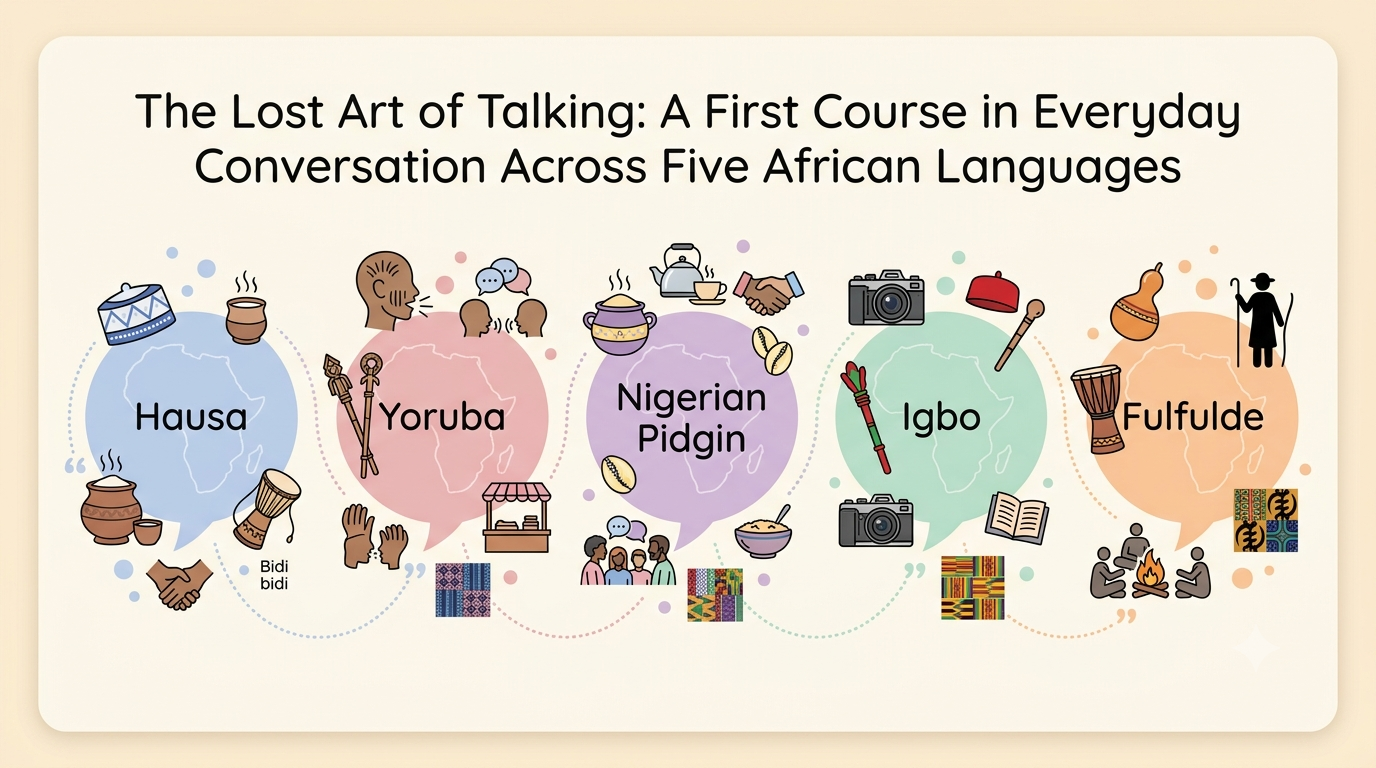
This course is about those conversations. We are going to explore fifty questions and answers for general conversation across five languages: Swahili, Oromo, Amharic, Fulani, and Lingala. These are not the phrases that save lives or seal deals. They are the phrases that make life feel human. They are the questions you ask when you are sitting on a mat, sharing tea, and simply passing the time.
Let us begin with a truth: in many African cultures, conversation is not a transaction. It is a relationship. You do not ask a question just to get an answer. You ask because you want to know the person. You ask because the act of asking is itself a form of care. In Fulani, a person who rushes a conversation is considered rude. In Oromo, the greeting and the small talk that follows are part of a ritual of peace. In Swahili, the phrase Starehe means to be at ease, and that is what good conversation produces.
So as we go through these fifty questions, do not treat them as vocabulary drills. Treat them as invitations. Each question is a door. Each answer is an opening.
---
The Fifty Questions and Answers
Below are fifty questions and answers for general conversation, organized by topic. Not every language has a direct translation for every phrase, but these are the ones that travel best. Learn them in the language you are studying, or learn a few in each. The goal is not perfection. The goal is connection.
Introductions and Getting to Know Someone
# English Swahili Oromo Amharic Fulani Lingala
1 What is your name? Jina lako ni nani? Maqaan ke eenyu? Simeh man now? Noy innde ma? Kombo na yo nani?
2 My name is... Jina langu ni... Maqaan koo... Simeh... Innde am... Kombo na ngai…
3 Where are you from? Unatoka wapi? Eessaa dhufte? Yet wedk? Toy a iwri? Owuti yo?
4 I am from... Natoka... ...dhufe ...negn Mi iwri... Nauti…
5 How old are you? Una miaka mingapi? Umriin ke meeqa? Amet shint hono? Duuɓi ma ɗeye? Mbula na yo boni?
6 I am... years old Nina miaka... Umriin koo... Amet... Mi woni duuɓi... Nazali na mbula…
7 What do you do? Unafanya kazi gani? Maal hojjatta? Min tiseraleh? Ko gollataa? Osalaka mosala nini?
8 I am a teacher Mimi ni mwalimu Barsiisaa dha Astemari negn Mi jannginoowo Nazali molakisi
9 Are you married? Umeoa? Heerumtee? Agebteh? Aɗa resa? Osali libala?
10 I am not married Sijaolewa Hin heerumne Alagebem Mi resaali Nabali libala te
Daily Life and Routines
# English Swahili Oromo Amharic Fulani Lingala
11 How are you today? Habari ya leo? Har'a akkam? Zare endet neh? Jam na hannde? Lelo ozali malamu?
12 I am fine, thank you Nzuri, asante Fayyaadha, galatoomi Dehna, ameseginalow Jam tan, jaraama Malamu, matondi
13 What did you do today? Ulifanya nini leo? Har'a maal hojjatte? Zare min serah? Ko waɗɗaa hannde? Osalaki nini lelo?
14 I went to work Nilikwenda kazini Hojii dhaqe Wede sera Mi yahi gollal Nakendeki mosala
15 Did you sleep well? Ulilala vizuri? Nagaan bulte? Dehna ederkeh? A waali jam? Olalaki malamu?
16 Yes, I slept well Ndiyo, nililala vizuri Eey, nagaan bulle Awo, dehna ederku Eey, mi waali jam Ee, nalalaki malamu
17 What do you eat? Unakula nini? Maal nyaatta? Min tibelaleh? Ko nyaɗataa? Olyaka nini?
18 I like this food Napenda chakula hiki Nyaata kana nan jaaladha Yih migib ewedalehu Mi yidi nyamdu ndu Nalingi bilia oyo
19 Are you tired? Umechoka? Dadhabdee? Dinkeheh? A ronkii? Ozali na nzela?
20 I am very tired Nimechoka sana Baay'ee dadhabe Betam dinkehu Mi ronkii sanne Nazali na nzela mingi
Hobbies and Interests
# English Swahili Oromo Amharic Fulani Lingala
21 What do you like to do? Unapenda kufanya nini? Maal gochuu jaallatta? Min madreg? Ko yiɗɗaa waɗde? Olingi kosala nini?
22 I like to read Napenda kusoma Dubbisuu nan jaaladha Manbeb alehu Mi yidi janngude Nalingi kotanga
23 I like to sing Napenda kuimba Weeddaluu nan jaaladha Mezmur alehu Mi yidi yimeede Nalingi koyemba
24 Do you play football? Unacheza mpira? Kubbaa miilaa taphatta? Kubbaa t'ewataleh? A fijiraa ball? Olingi kosala football?
25 Music is my life Muziki ni maisha yangu Muuziqni jireenya koo ti Mizika yihiyew new Muusik woni nguurndam am Miziki ezali bomoyi na ngai
26 What kind of music do you like? Unapenda muziki wa aina gani? Muuziqaa akkam jaallatta? Yih mizika min wedaleh? Muusik noy yiɗɗaa? Olingi miziki nini?
27 I like traditional music Napenda muziki wa kitamaduni Muuziqaa aadaa jaaladha Bahlawi mizika ewedalehu Mi yidi muusik aada Nalingi miziki ya bonkoko
28 Do you like to travel? Unapenda kusafiri? Imaluu jaallatta? Mewededaleh? A yiɗi yahde? Olingi kokende?
29 I want to visit your country Nataka kutembelea nchi yako Biyya ke daawwachuu barbaada Hagerih bit'emagnalehu Mi yiɗi yillaade leydi ma Nalingi kokende na mboka na yo
30 Tell me about your family Niambie kuhusu familia yako Maatii kee irratti naaf himi Betesebihiginaw Haalanam e ɓesngu ma Yebisa ngai libota na yo
Making Plans and Invitations
# English Swahili Oromo Amharic Fulani Lingala
31 What are you doing tomorrow? Unafanya nini kesho? Boru maal hojjatta? Nege min tiseraleh? Ko waɗɗataa jaŋngo? Okosala nini lobi?
32 I am free tomorrow Niko huru kesho Boru bilisaan jira Nege free negn Mi ndimaani jaŋngo Nazali libre lobi
33 Do you want to go together? Unataka twende pamoja? Waliin deemuu barbaadda? Ande yihon? A yiɗi yahde bee? Olingi tokende elongo?
34 Yes, let's go Ndiyo, twende Eey, haa deemu Awo, inhed Eey, ndeen Ee, tokende
35 What time should we meet? Tukutane saa ngapi? Sa'aatii meeqa wal arganna? Sint saat inigenagg? Ndee waktu ndeen? Tokutana ngonga nini?
36 Let's meet at... Tukutane saa... Sa'aatii... wal arganna Be... inigenagg Ndeen waktu... Tokutana na…
37 I will call you Nitakupigia simu Si bilbila nan godha Ilikalehu Mi noddataa ma Nakobenga yo
38 Are you busy? Uko na shughuli? Hojii qabdaa? Sira aleh? Aɗa gollal? Ozali na mosala?
39 I am not busy Sina shughuli Hojii hin qabu Sira yellem Mi gollalali Nazali na mosala te
40 I am sorry, I cannot Samahani, siwezi Dhiifama, hin danda'u Aznalehu, alchilim Hakkilo, mi waawi Limbisa ngai, nakoki te
Feelings and Opinions
# English Swahili Oromo Amharic Fulani Lingala
41 How do you feel? Unajisikia vipi? Akkam sitti dhaga'ama? Endet yihisal? No njiɗi? Oyokaka ndenge nini?
42 I am happy Nina furaha Gammachuun qaba T'iri alehu Mi naɓa weltaare Nazali na esengo
43 I am sad Nina huzuni Gadda qaba Aznalehu Mi naɓa suno Nazali na mpasi
44 I am angry Nina hasira Aare qaba T'iyak'alehu Mi naɓa tikkere Nazali na kanda
45 I am scared Nina hofu Na soda Fireyalehu Mi naɓa kulol Nazali na bobangi
46 What do you think? Unafikiri nini? Maal yaadda? Min tibelaleh? Ko miijotaa? Okanisi nini?
47 I think it is good Nadhani ni vizuri Gaarii nan yaada Gud new ibelalehu Mi yiɗi ko weli Nakanisi ezali malamu
48 I agree Nakubali Walii gale Ewedalehu Mi jaɓi Nandimi
49 I disagree Sikubali Walii hin galle Alwedem Mi jaɓaali Nandimi te
50 That is interesting Hiyo ni ya kuvutia Kun nama hawwata Yih yasasiqal Ndun weltaare Wana ezali kitoko
---
The Grammar Beneath the Chat
Conversation is not just vocabulary. It is rhythm. It is the way a language moves when it is not trying to be formal.
In Swahili, questions often end with wapi (where), nini (what), or gani (which kind). These little words are the keys to asking. Unafanya nini?—"What are you doing?" The verb fanya means "do," and nini makes it a question. Simple.
Oromo uses question words like maal (what), eessa (where), and akkam (how). Maal hojjatta?—"What do you do?" The verb comes at the end, which is typical of Oromo sentence structure.
Amharic places the verb at the end as well. Min tiseraleh?—"What do you do?" The min is "what," and tiseraleh is "you do." The question word comes first, but the verb anchors the sentence.
Fulani is a language of suffixes. Ko gollataa?—"What do you do?" The -aa at the end marks the present tense. The ko is "what." The grammar is in the endings.
Lingala is more flexible. Osalaka nini?—"What do you do?" The verb salaka means "do," and nini means "what." The word order is similar to English, which makes it easier for beginners.
---
How to Practice Conversation
You cannot learn conversation from a table. You learn it by having conversations.
Start with one question. Pick the one that feels most natural to you. Jina lako ni nani? Maqaan ke eenyu? Simeh man now? Ask it to yourself. Ask it to a friend. Ask it to the mirror.
Learn the answer. A question without an answer is a dead end. Learn how to say your name, where you are from, what you do. These are the building blocks of identity.
Practice the follow-up. Conversation is a series of small moves. You ask a question, you listen to the answer, and then you ask another question based on what you heard. Unatoka wapi? Natoka Kenya. Ah, Kenya ni nzuri! This is how conversations grow.
Listen to how people actually talk. Watch interviews with Swahili speakers. Listen to Oromo music. Watch Amharic films. Pay attention to the rhythm, the pauses, the laughter. Conversation is not just words. It is music.
Be curious. The best conversationalists are not the ones with the biggest vocabulary. They are the ones who are genuinely interested in the person in front of them. Ask questions because you want to know, not because you want to practice.
---
The Fifty-First Question
There is one question that is not on the list. It is the question you ask yourself when the conversation is over: Did I listen?
Conversation is not about talking. It is about connecting. You can ask all fifty questions in perfect Swahili, but if you are not listening to the answers, you have missed the point. The goal is not to show off your language skills. The goal is to know another person.
So learn these phrases. Use them. But remember that the most important word in any conversation is the one you say after you have listened. And that word is usually just Asante. Galatoomi. Ameseginalow. Jaraama. Matondi.
Thank you for talking with me.

Leave a comment
Your email address will not be published. Required fields are marked *