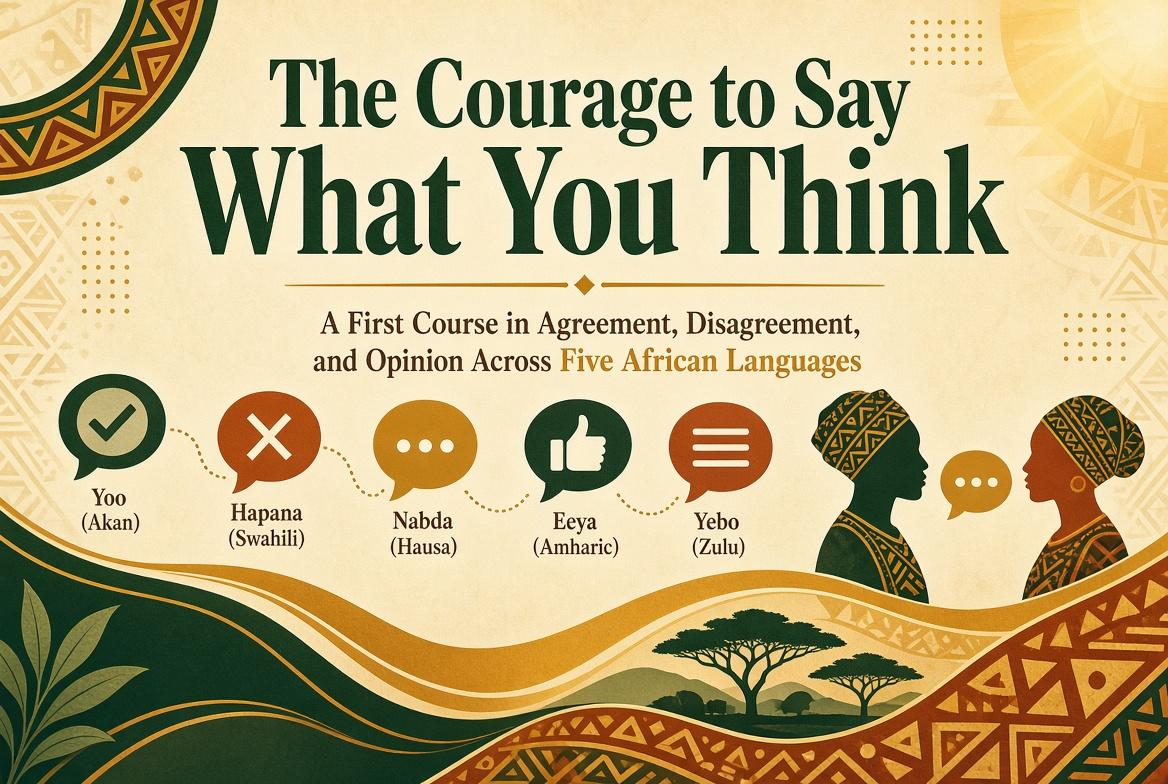
There is a moment in every conversation when you have to decide. Do you agree? Do you disagree? Do you stay silent? Or do you speak your mind and risk the discomfort of conflict?
In many African cultures, this moment is not taken lightly. Speech is powerful. Words can build or destroy. A careless opinion can wound a relationship that took years to build. A well-placed agreement can strengthen a bond. A respectful disagreement can deepen trust. The art of conversation is not just about talking. It is about knowing when to speak, how to speak, and what to say.
This course is about that art. We are going to explore fifty questions and answers about agreeing, disagreeing, finding similarities, noting differences, and stating opinions across five languages: Swahili, Oromo, Amharic, Fulani, and Lingala. These are the phrases you use when you want to be honest without being harsh, when you want to be heard without being rude.
Let us begin with a truth: in many African cultures, the community comes before the individual. This means that stating your opinion is not just about expressing yourself. It is about contributing to the group. It is about adding your voice to the chorus. But it also means that you must be careful. Your voice can harmonize or it can clash. The choice is yours.
In Swahili, there is a proverb: Ukimya ni kukubali. Silence is agreement. But there is another proverb: Penye ukweli, utangulie. Where there is truth, let it come first. These two proverbs are in tension. They remind us that sometimes silence is wisdom, and sometimes silence is cowardice. The art is knowing the difference.
So as we go through these fifty questions, think of them as tools. Each one helps you navigate the delicate terrain of human interaction. Each one helps you speak your truth with grace.
---
The Fifty Questions and Answers
Below are fifty questions and answers about agreement, disagreement, similarities, differences, and opinions, organized by topic. Not every language has a direct translation for every phrase, but these are the ones that travel best. Learn them in the language you are studying, or learn a few in each. The goal is not perfection. The goal is honesty.
Agreeing
# English Swahili Oromo Amharic Fulani Lingala
1 I agree Nakubali Walii gale Ewedalehu Mi jaɓi Nandimi
2 Yes, I agree Ndiyo, nakubali Eey, walii gale Awo, ewedalehu Eey, mi jaɓi Ee, nandimi
3 You are right Uko sahihi Sirrii dha T'iru neh A tawii Ozali solo
4 That is true Hiyo ni kweli Kun dhugaa Yih ewnet new Ndee ɗum goonga Yango ezali solo
5 Exactly Hasa Sirriitti Betam Ko ɗum Mpenza
6 I think so too Nadhani hivyo pia Anis akkas nan yaada Enehom indayalew Mi kadi mi yiɗi Ngai mpe nakanisi bongo
7 That makes sense Hiyo inaeleweka Kun hubatama Yih yit'egnal Ndee ɗum famɗi Yango ezali malamu
8 I am with you Niko nawe Si waliin jira Kegna alehu Mi woni e ma Nazali na yo
9 Absolutely Kabisa Guutummaatti Be'iruw Pati Mpenza mpenza
10 You are correct Uko sahihi Sirrii dha T'iru neh A tawii Ozali solo
Disagreeing
# English Swahili Oromo Amharic Fulani Lingala
11 I disagree Sikubali Walii hin galle Alwedem Mi jaɓaali Nandimi te
12 No, I do not agree Hapana, sikubali Lakkii, walii hin galle Aye, alwedem Ala, mi jaɓaali Te, nandimi te
13 I see it differently Naona tofauti Adda nan ilaala Belela abyalehu Mi yi'i ɗum no feere Namona yango ndenge mosusu
14 That is not true Hiyo si kweli Kun dhugaa miti Yih ewnet aydelem Ndee ɗum goongaani Yango ezali solo te
15 I do not think so Sidhani hivyo Akkas hin yaadu Indayalew Mi yiɗaa ɗum Nakanisi bongo te
16 I am not sure Sina uhakika Hin mirkaneeffadhu Erek'alehu Mi tabitinaani Nazali na tembe te
17 I understand, but... Naelewa, lakini... Hubadhe, garuu... Gebagnalehu, gini... Mi fami, kono... Nayoki, kasi…
18 With respect, I disagree Kwa heshima, sikubali Kabajaan, walii hin galle Be'irk'eta, alwedem E teddungal, mi jaɓaali Na limemya, nandimi te
19 Let us agree to disagree Tukubaliane kutokukubaliana Walii galuu fi walii galuu dhabuu irratti haa waliin galle Indewededu inidemem Ndeen jaɓde ko min jaɓaani Tokondima e likambo oyo
20 You are wrong Ume kosea Dogoggorte T'ifiteh A bonnii Ozali na libunga
Similarities and Differences
# English Swahili Oromo Amharic Fulani Lingala
21 We are the same Sisi ni sawa Nuti tokko Ande and new Min gootum Tozali ndenge moko
22 We are different Sisi ni tofauti Nuti adda Ande yeteleyayew Min ceertuɗe Tozali kokesena
23 This is similar to that Hii inafanana na hiyo Kun kana fakkaata Yih yihin yimeselal Ndee ɗum nanndi e ɗum Oyo ezali ndenge moko na yango
24 This is different from that Hii ni tofauti na hiyo Kun kana irraa adda Yih yihin yiteleyal Ndee ɗum ceerti e ɗum Oyo ezali kokesena na yango
25 What do we have in common? Tuna nini sawa? Maal waliin qabna? Min yigibiral? Ko wondude min njogii? Nini tozali na yango elongo?
26 We both like... Sisi wote tunapenda... Lamaanuu...jaallanna Huletachin...inwedal Enen ɗiɗo...min yiɗi Biso mibale tolingi…
27 I see the difference Naona tofauti Adda nan arga Yeteyayew ayyalehu Mi yi'i ceertugol Namona bokeseni
28 There is no difference Hakuna tofauti Adda hin jiru Yeteleyayew yellem Ceertugol alaa Bokeseni ezali te
29 They are like brothers Wao ni kama ndugu Obboleeyyoota fakkaatu Wenmedoch yimeslalu Ɓe nanndi e miñiɓɓe Bazali lokola bandeko
30 We share the same values Tunashirikiana maadili sawa Duudhaa tokko qabna Yemigbar and new Min njogii gootum Tozali na makambo moko
Stating Your Opinion
# English Swahili Oromo Amharic Fulani Lingala
31 I think... Nadhani... Nan yaada... Indayalew... Mi yiɗi... Nakanisi…
32 In my opinion... Kwa maoni yangu... Yaada kootti... Be'abiyew... E yiɗde am... Na makanisi na ngai…
33 I believe... Naamini... Nan amana... Anatew... Mi ngoongɗini... Nandimi…
34 I feel that... Nahisi kwamba... Nan dhaga'a... Yihisal... Mi nanaa... Nayoki ete…
35 It seems to me... Inaonekana kwangu... Natti fakkaata... Innelalew... Mi yi'i... Emonisaka ngai…
36 I am sure that... Nina uhakika kwamba... Nan mirkaneeffadha... Erek'alehu... Mi tabitini... Nazali na tembe ete…
37 I am not sure, but... Sina uhakika, lakini... Hin mirkaneeffadhu, garuu... Erek'alehu, gini... Mi tabitinaani, kono... Nazali na tembe te, kasi…
38 What do you think? Unafikiri nini? Maal yaadda? Min tibelaleh? Ko miijotaa? Okanisi nini?
39 What is your opinion? Maoni yako ni nini? Yaadaan ke maali? Abiyih min new? Ndee yiɗde ma? Makanisi na yo nini?
40 Let me explain my view Niache nieleze maoni yangu Yaada koo ibsuu naaf hayyami Abiyew indibegn Mi faccina yiɗde am Bika nayebisa makanisi na ngai
Debating and Discussing
# English Swahili Oromo Amharic Fulani Lingala
41 Let us discuss this Hebu tujadili hili Waa'ee kana haa dubbannu Be'ize ininaged Ndeen haalude ɗum Tokosolo yango
42 I see your point Naona hoja yako Yaada kee nan arga Abiyih ayyalehu Mi yi'i yiɗde ma Namona makanisi na yo
43 That is a good point Hiyo ni hoja nzuri Kun yaada gaarii Yih t'iru abiy new Ndee ɗum yiɗde moƴƴere Yango ezali makanisi malamu
44 I understand your position Naelewa msimamo wako Murtii kee hubadhe Akabarih gebagnalehu Mi fami darnde ma Nayoki esika na yo
45 Let me finish Niache nimalize Akkan xumuru Indigim Mi faccina gollitde Bika ndisila
46 Can I say something? Naweza kusema kitu? Waan jedhuu danda'aa? Waan inbelalehu? Mi mbaawi wiye ko? Nakoki koloba eloko?
47 Let us find a solution Tutafute suluhisho Furmaata haa barbaadnu Yemamri ininil Ndeen yiytude feere Tokaluka eyano
48 We can agree on this Tunaweza kukubaliana kuhusu hili Waa'ee kana walii galuu dandeenya Be'ize inidewemed Min mbaawi jaɓde ɗum Tokoki kondima yango
49 Let us respect each other's views Tuheshimu maoni ya kila mmoja Yaada walii kabajjuu Ye'abiyachin inik'iberu Ndeen teddinde yiɗde kala Tokumisa makanisi ya bato
50 Thank you for sharing your opinion Asante kwa kushiriki maoni yako Yaada keetiif galatoomi Abiyih ameseginalow Jaraama yiɗde ma Matondi mpo na makanisi na yo
---
The Grammar of Opinion
The grammar of opinion is the grammar of the self. It is about saying, “This is what I think. This is what I believe. This is what I feel.”
In Swahili, the verb kudhani means "to think" or "to suppose." Nadhani means "I think." It is a soft word. It does not claim certainty. It leaves room for doubt. When you say Nadhani, you are saying, “This is my view, but I am open to hearing yours.”
In Oromo, the verb yaaduu means "to think" or "to remember." Nan yaada means "I think." It is a word of reflection. It implies that you have considered the matter. It is not a rash opinion. It is a considered one.
In Amharic, the verb mayet means "to see." But indayalew means "I think." It is literally, "It seems to me." The verb is about perception. It is about how things appear to you. It is not a claim of absolute truth.
In Fulani, the verb yiɗde means "to love" or "to want." But it is also used to express opinion. Mi yiɗi means "I think" or "I want." It is a word of desire. It is about what you are drawn toward.
In Lingala, the verb kokanisa means "to think." Nakanisi means "I think." It is a word of the mind. It is about reasoning. It is about using your head.
---
How to Practice Agreement and Disagreement
You cannot learn to agree and disagree without practicing.
Start with agreement. It is easier to agree than to disagree. Practice saying, "I agree," "You are right," "That is true." Say them with a smile. Feel the warmth of connection.
Then practice disagreement. This is harder. Practice saying, "I see it differently," "I understand, but...," "With respect, I disagree." Say them calmly. Feel the strength of honesty.
Find similarities. When you meet someone new, look for things you have in common. Practice saying, "We are the same," "We both like...," “We share the same values.”
Note differences. Differences are not threats. They are opportunities. Practice saying, "We are different," "This is different from that," “I see the difference.”
State your opinion. Do not be afraid to speak. Practice saying, "I think...," "In my opinion...," "I believe..." Your voice matters. Your perspective is valuable.
Listen. Agreement and disagreement are not just about speaking. They are about listening. When someone shares their opinion, listen. Try to understand. Then respond.
---
The Fifty-First Question
There is one question that is not on the list. It is the question you ask yourself when you have learned all fifty phrases: Am I being honest?
Agreement and disagreement are not about being right. They are about being real. You can agree with someone just to avoid conflict. You can disagree with someone just to assert your ego. Neither is honest. Neither is helpful.
The goal is not to win. The goal is to connect. To say, “This is what I think, and I respect what you think. Let us find a way forward together.”
In Swahili, there is a proverb: Umoja ni nguvu. Unity is strength. But unity does not mean uniformity. It means diversity held together by respect. It means different voices singing in harmony.
So learn these phrases. Use them. But remember that the most important thing you can bring to a conversation is not your opinion. It is your honesty. It is your willingness to speak the truth in love.
And that honesty needs no translation.
It is called integrity.

Leave a comment
Your email address will not be published. Required fields are marked *