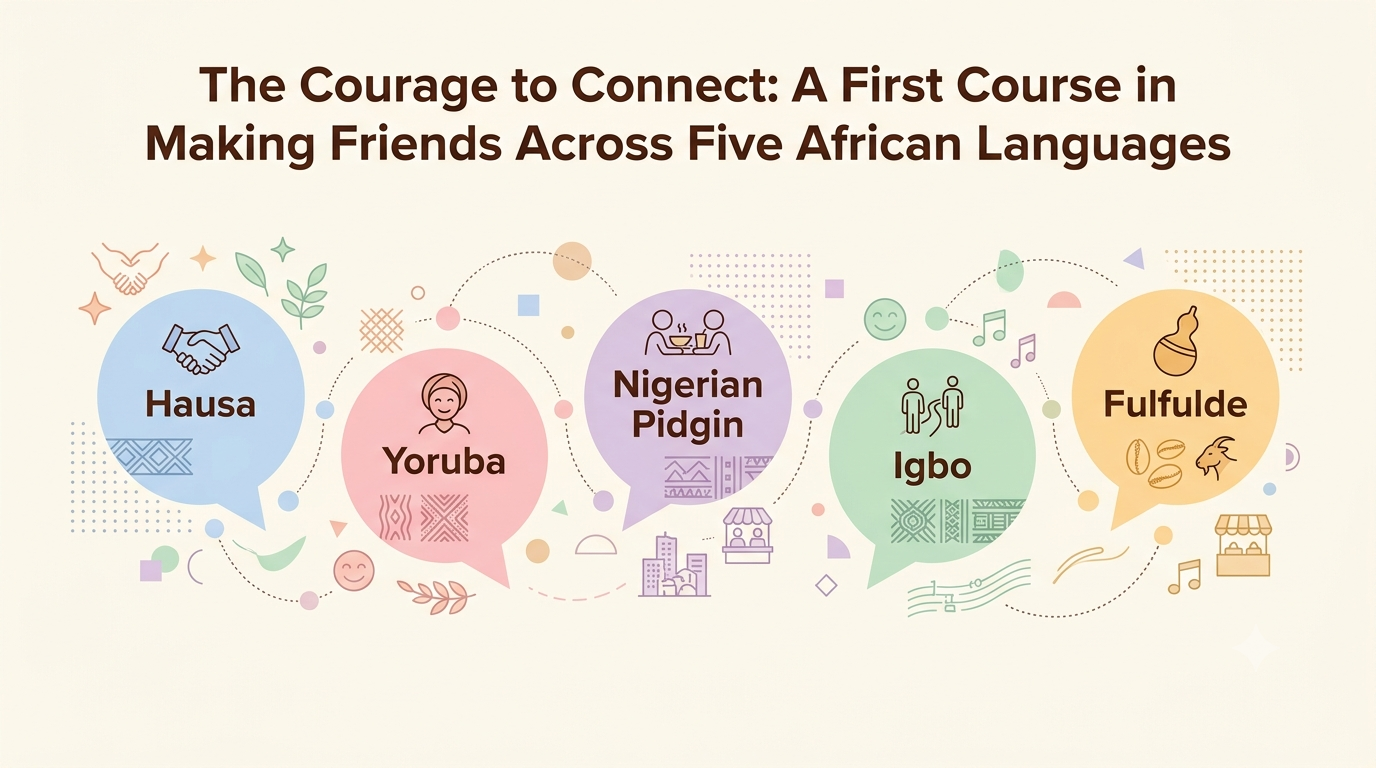
There is a particular kind of loneliness that comes from being surrounded by people you cannot talk to. You see them laughing, arguing, telling stories, and you are there but not there. You are a ghost at the feast. And then one day, you learn a single phrase in their language, and something shifts. A door opens. You are no longer a stranger. You are a potential friend. This course is about that shift. We are going to explore fifty questions and answers about making friends across five languages: Swahili, Oromo, Amharic, Fulani, and Lingala. These are not the phrases of business or emergency. They are the phrases of belonging. They are the words you use when you want to move from the edge of the circle to the center. Making friends in a new language is an act of vulnerability. You will sound strange. You will make mistakes. You will say the wrong thing at the wrong time. But here is the secret that every language learner eventually discovers: people do not remember your mistakes. They remember your effort. The fact that you tried to speak their language is itself a form of friendship. It says, "I want to know you. I want to be part of your world." So let us begin. Let us learn how to make friends. --- The Fifty Questions and Answers Below are fifty questions and answers for making friends, organized by the stages of friendship. Not every language has a direct translation for every phrase, but these are the ones that travel best. Learn them in the language you are studying, or learn a few in each. The goal is not fluency. The goal is connection. Breaking the Ice: First Encounters # English Swahili Oromo Amharic Fulani Lingala 1 Hello, my friend Habari, rafiki yangu Akkam, michuu koo Selam, wedaje Sannu, sehil am Mbote, moninga na ngai 2 What is your name? Jina lako ni nani? Maqaan ke eenyu? Simeh man now? Noy innde ma? Kombo na yo nani? 3 My name is... Jina langu ni... Maqaan koo... Simeh... Innde am... Kombo na ngai... 4 Nice to meet you Nimefurahi kukutana nawe Si arguu nan gammachuu qaba Si metah t'irign Mi weltaake hawrugol ma Nasepeli mpenza koyoka yo 5 Where are you from? Unatoka wapi? Eessaa dhufte? Yet wedk? Toy a iwri? Owuti yo? 6 I am from... Natoka... ...dhufe ...negn Mi iwri... Nauti... 7 How long have you been here? Umekuwa hapa kwa muda gani? As gaafii meeqa as jirta? Sint zemen sirah? Ndee dumunnde a woni ɗoo? Ozali awa banda ntango boni? 8 I just arrived Nimefika tu Amma nan dhufe Ahun negn Mi ardi jooni Nakomi kaka sikoyo 9 Do you live here? Unaishi hapa? As jiraatta? Izih yinoral? A woni ɗoo? Ofandaka awa? 10 Yes, I live nearby Ndiyo, naishi karibu Eey, dhiyoo nan jira Awo, biyachin enoralew Eey, mi woni ɓadiiɗo Ee, nafandaka pene Finding Common Ground # English Swahili Oromo Amharic Fulani Lingala 11 What do you do? Unafanya kazi gani? Maal hojjatta? Min tiseraleh? Ko gollataa? Osalaka mosala nini? 12 I am a student Mimi ni mwanafunzi Barataa dha Temari negn Mi janngoowo Nazali mwana ya kelasi 13 What are your hobbies? Una shughuli gani za burudani? Maal gochuu jaallatta? Min madreg? Ko yiɗɗaa waɗde? Olingi kosala nini? 14 I like music Napenda muziki Muuziqaa nan jaaladha Mizika ewedalehu Mi yidi muusik Nalingi miziki 15 Do you like football? Unapenda mpira? Kubbaa miilaa jaallatta? Kubbaa t'ewataleh? A yiɗi ball? Olingi football? 16 What music do you listen to? Unasikiliza muziki gani? Muuziqaa akkam dhaggeeffatta? Yih mizika tinataleh? Ndee muusik a nantaa? Oyingaka miziki nini? 17 We have the same taste Tunapenda kitu kimoja Waan tokko jaallanna Ande yihon inwedal Min njogii gootum Tolingi eloko moko 18 Do you like to travel? Unapenda kusafiri? Imaluu jaallatta? Mewededaleh? A yiɗi yahde? Olingi kokende? 19 I want to learn your language Nataka kujifunza lugha yako Afaan kee barachuu barbaada Qwanqwahesh itenagnalehu Mi yiɗi ekkita ɗemngal ma Nalingi koyekola monoko na yo 20 You speak English very well Unazungumza Kingereza vizuri sana Afaan Ingiliizi baay'ee gaarii dubbatta English betam t'inagereh A wolwa Anglais sanne Olobaka Lingelésa malamu mingi Deepening the Connection # English Swahili Oromo Amharic Fulani Lingala 21 Tell me about your family Niambie kuhusu familia yako Maatii kee irratti naaf himi Betesebihiginaw Haalanam e ɓesngu ma Yebisa ngai libota na yo 22 I have two brothers Nina ndugu wawili wa kiume Obboleeyyaa lama qaba Hulet wenmed alehu Mi naɓa miñiɓɓe ɗiɗo Nazali na bandeko mibali mibale 23 Do you have children? Una watoto? Ijoollee qabdaa? Lijoch aleh? Aɗa ɓiɓɓe? Ozali na bana? 24 What do you believe in? Unaamini nini? Maal amanta? Min tanataleh? Ko ngoongɗini? Ondimaka nini? 25 I respect your culture Naheshimu utamaduni wako Aadaa kee nan kabaja Bahlwih enewedalehu Mi teddinaa aada ma Nazali na limemya bonkoko na yo 26 What makes you happy? Nini kinakufurahisha? Maal si gammachiisa? Min t'irih yadergal? Ko weltinta? Nini esepelisaka yo? 27 What makes you sad? Nini kinakuhuzunisha? Maal si gaddisiisa? Min aznih yadergal? Ko suna ma? Nini epesaka yo mpasi? 28 I understand how you feel Naelewa unavyojisikia Akkam sitti dhaga'amu hubadhe Endet yihisal gebagnalehu Mi fami no njiɗi Nayoki ndenge oyokaka 29 You can trust me Unaweza kuniamini Na amanuu dandeessa Litamagnaleh A mbaawi hoolaade lam Okoki kotiya ngai 30 I am here for you Niko hapa kwa ajili yako Siif jira Kegna alehu Mi woni ɗoo sabu ma Nazali awa mpo na yo Spending Time Together # English Swahili Oromo Amharic Fulani Lingala 31 Do you want to hang out? Unataka kukaa pamoja? Waliin jiraachuu barbaadda? Ande yihon? A yiɗi wonndude? Olingi tokutana? 32 Let's get something to eat Twende tukale chakula Nyaata haa nyaannu Migib inbil Ndeen nyaamdu Tokende tolya bilia 33 I will pay for you Nitakulipia Si kaffalaa Ilikalehu Mi yoɓtataa ma Nakofuta mpo na yo 34 Thank you, you are kind Asante, wewe ni mkarimu Galatoomi, ati nama gaarii dha Ameseginalow, kind neh Jaraama, a neɗɗo moƴƴo Matondi, ozali malamu 35 Come to my house Njoo nyumbani kwangu Garaa kootti koottu Betoche inna Waraa e galle am Yaka na ndako na ngai 36 I will cook for you Nitakupikia Si bilcheessaa Ilikalehu Mi defantaa ma Nakotumba mpo na yo 37 What is your phone number? Namba yako ya simu ni nini? Lakkoofsa bilbilaa ke meeqa? Silkih k'ut'er yet new? Ndee limoore telefo ma? Nimero ya telefone na yo nani? 38 Let's meet tomorrow Tukutane kesho Boru wal arganna Nege inigenagg Ndeen jaŋngo Tokutana lobi 39 I had a good time Nimefurahi sana Baay'ee gammade Betam t'irign Mi weltaake sanne Nasepelaki mingi 40 See you later, my friend Tutaonana baadaye, rafiki yangu Booda wal arganna, michuu koo Dehna hun, wedaje Sey yeeso, sehil am Tokomonana, moninga na ngai Resolving Problems and Showing Loyalty # English Swahili Oromo Amharic Fulani Lingala 41 I am sorry if I offended you Samahani kama nilikukosea Yoo si hanqadde dhiifama Yek'irtagnalehu Ya mi bonnii ma hakkilo Limbisa ngai soki nasaleli yo 42 I did not mean it Sikukusudia Kaayyoo kootii miti Alkaayehum Mi waɗaani ɗum e ɓernde Nalingaki kosala yango te 43 Let us talk about it Hebu tuzungumze Waa'ee isaa haa dubbannu Be'ize ininaged Ndeen haalude ɗum Tokosolo yango 44 I forgive you Nimekusamehe Si dhiifame Aznih t'ewalehu Mi yaafanike Nalimbisi yo 45 Do not be angry with me Usinikasirikie Na hin aarin Atinik'aw Taa tikkere lam Kanda na ngai te 46 We are still friends Bado ni marafiki Ammayyuu michuu dha Ahun wedajochin Min keɓi sehilaaɓe Tokomi bamoninga 47 I will stand by you Nitakusimamia Si bira nan jira Kegna alehu Mi daraa ma Nakotela yo 48 You are like a brother to me Wewe ni kama ndugu yangu Akka obboleessa kootti nan siila Wendeh wenmedeh A waɗi miñiraaɗo am Ozali ndeko na ngai 49 You are like a sister to me Wewe ni kama dada yangu Akka obboleettii kootti nan siila Wendeh eheteh A waɗi debbo am Ozali ndeko na ngai ya mwasi 50 Friendship is a treasure Urafiki ni hazina Michuummaan qabeenya Wedajinet mesmer new Sehilaaɗe ngalu Boninga ezali bomengo --- The Grammar of Friendship The language of friendship is different from the language of formality. It is looser. It is warmer. It uses more contractions, more slang, more inside jokes. In Swahili, friends often use the informal Mambo? instead of Habari? The reply Poa is casual and cool. You do not use Shikamoo with your friends. That is for elders. With friends, you drop the formality and speak from the heart. Oromo friends use Akkam? freely. The language does not have the same rigid formal and informal registers as some others. But there is a difference in tone. With friends, the Akkam is lighter. It is not a question. It is a nod. Amharic has different verb forms for different relationships. Endet neh? to a male friend, Endet nesh? to a female friend. But between close friends, you might drop the question entirely and simply say Dehna?—"Fine?" It is shorthand. It is intimacy. Fulani is a language of respect, but friendship is where the formality softens. The word sehil means friend. When you call someone sehil am—"my friend"—you are claiming them. You are saying, "You are mine, and I am yours." Lingala is perhaps the most casual of the five. Mbote is universal. Moninga means friend. The language of Kinshasa is full of slang and playfulness. When you call someone moninga na ngai, you are not just saying "my friend." You are saying, "You are part of my crew." --- How to Practice Friendship Language You cannot learn friendship from a book. You learn it by being a friend. Start with one person. Find someone who speaks the language you are learning. Practice one phrase a day. Ask them to correct you. Let them laugh at your mistakes. That laughter is the beginning of friendship. Be vulnerable. The fear of sounding stupid is the enemy of connection. Say the wrong thing. Ask the awkward question. People will forgive you. They will help you. Learn their story. Friendship is built on stories. Ask about their childhood. Ask about their dreams. Ask about the things that make them laugh and the things that make them cry. Show up. Language is not enough. You have to be present. You have to share meals. You have to sit in silence. You have to be there when it matters. --- The Fifty-First Question There is one question that is not on the list. It is the question you ask yourself when you have learned all fifty phrases: Am I a good friend? Language is a tool for connection, but it is not the connection itself. You can speak perfect Swahili and still be a stranger. You can stumble through Amharic and become a brother. The question is not whether you can say the words. The question is whether you mean them. When you say Rafiki yangu, do you mean it? When you say Michuu koo, do you feel it? Friendship is not a vocabulary. It is a commitment. So learn these phrases. Use them. But remember that the most important thing you can say to a friend is not a phrase at all. It is your presence. And that presence needs no translation.

Leave a comment
Your email address will not be published. Required fields are marked *