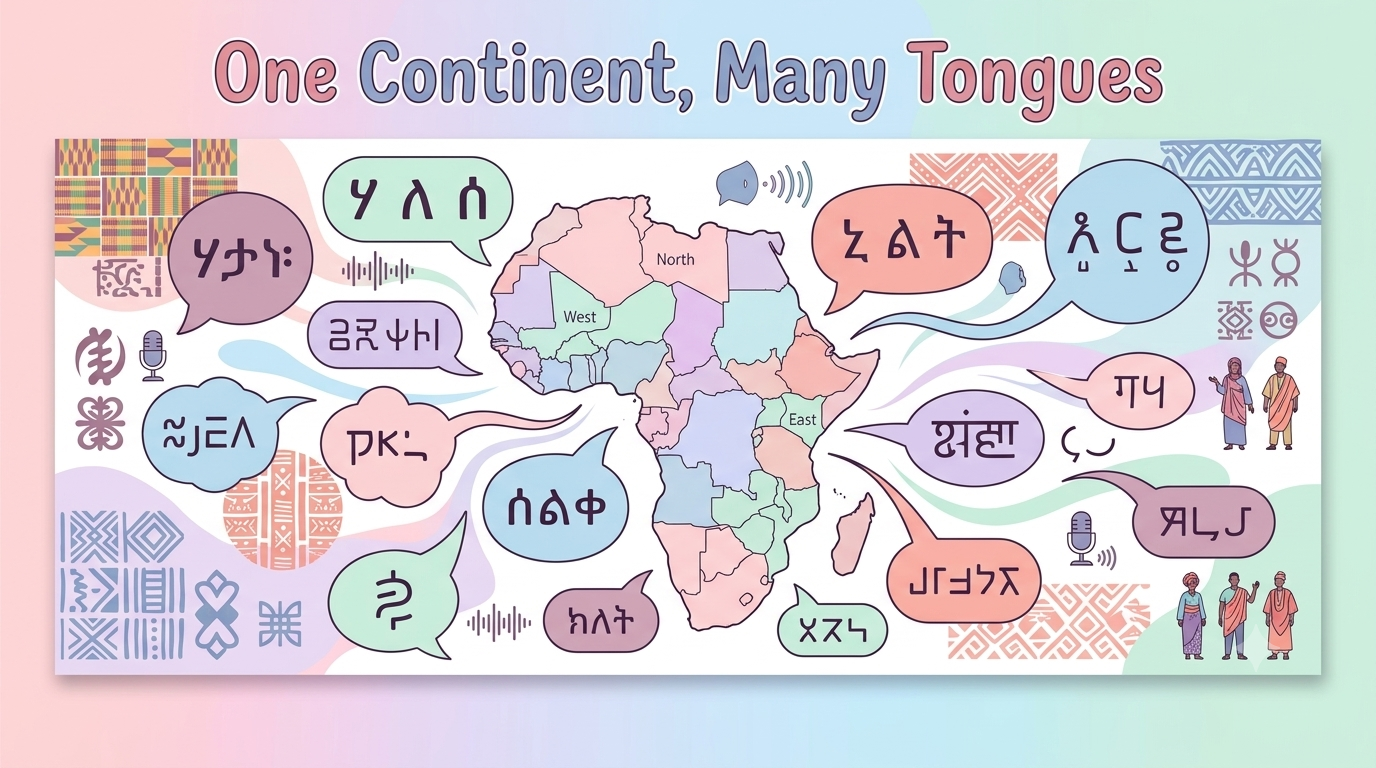
Africa is not a country. It is a continent of fifty-four nations, over two thousand languages, and countless cultures. And yet, when people outside the continent hear the word "Africa," they often imagine a single place, a single people, a single way of speaking. Nothing could be further from the truth. The languages we have explored in this series—Hausa, Yoruba, Nigerian Pidgin, Igbo, Fulfulde, Swahili, Fulani, Oromo, Amharic, and Lingala—are not variations of the same theme. They are different worlds. They belong to different language families. They carry different histories. They sing different songs.
This final article is about those differences. We are going to compare these ten languages—not to rank them, not to judge them, but to understand them. We will look at where they come from, how they are structured, how they sound, and how they are used. By the end, you will see that the diversity of African languages is not a problem to be solved. It is a treasure to be celebrated.
Let us begin with a truth: the differences between these languages are not just linguistic. They are historical. They are cultural. They are spiritual. To learn a language is to enter a world. To compare languages is to compare worlds.
---
The Language Families: Where Do They Come From?
The first major difference between these languages is their family. Linguists group languages into families based on shared ancestry. Just as English, German, and Dutch are cousins in the Germanic family, African languages belong to different families that diverged thousands of years ago.
The Afro-Asiatic Family
Hausa, Amharic, and Oromo belong to the Afro-Asiatic family. This is one of the oldest language families in the world, stretching back thousands of years. It includes Arabic, Hebrew, and Berber.
Hausa is a Chadic language, spoken primarily in northern Nigeria and Niger. It is the most widely spoken language in Nigeria as a first language, and it is used as a lingua franca across West Africa. Hausa has absorbed many words from Arabic due to centuries of trade and Islamic scholarship.
Amharic is a Semitic language, spoken in Ethiopia. It is related to Arabic and Hebrew, though distantly. Amharic is written in the fidel script, a unique syllabary that has no relation to the Latin alphabet. It is the official working language of Ethiopia and carries the weight of an ancient literary tradition.
Oromo is a Cushitic language, also spoken in Ethiopia, primarily by the Oromo people, the largest ethnic group in the country. It is related to Somali and Afar. Oromo was historically an oral language, but it now uses a Latin-based script called Qubee.
The Niger-Congo Family
Yoruba, Igbo, Fulfulde, Swahili, Lingala, and Fulani belong to the Niger-Congo family, one of the largest language families in the world. This family includes hundreds of languages spoken across sub-Saharan Africa.
Yoruba is spoken in southwestern Nigeria and parts of Benin and Togo. It is a tonal language with a rich literary tradition and a deep connection to the orisha religion, which has spread to the Americas through the transatlantic slave trade.
Igbo is spoken in southeastern Nigeria. It is also tonal and has many dialects, some of which are mutually unintelligible. The standard Igbo used in schools and media is based on the Owerri and Umuahia dialects.
Fulfulde, also called Fula or Pulaar, is the language of the Fulani people, a pastoralist group spread across West and Central Africa. It is spoken from Senegal to Sudan, making it one of the most geographically dispersed languages on the continent. Fulfulde has many dialects, but they share a common core.
Swahili is spoken along the East African coast, from Kenya to Mozambique. It is a Bantu language, but it has absorbed many words from Arabic, Persian, Portuguese, and English due to centuries of trade. Swahili is the most widely spoken lingua franca in East Africa and is an official language of the African Union.
Lingala is spoken in the Democratic Republic of Congo and the Republic of Congo. It is a Bantu language that grew along the Congo River. It is the language of the cities, of Kinshasa and Brazzaville, and it has a lively, musical quality.
Fulani is another name for the Fulfulde language and the people who speak it. The term "Fulani" is often used in English, while "Fulfulde" refers to the language itself.
The Creole Exception
Nigerian Pidgin is different from all the others. It is not a traditional African language in the same sense. It is an English-based creole, born from contact between English colonizers and the diverse peoples of Nigeria. It has its own grammar, its own vocabulary, and its own rules. It is not "broken English." It is a full language, spoken by millions as a first or second language. It is the language of the street, of the market, of the people.
---
Tone: The Music of Meaning
One of the most striking differences between these languages is their use of tone. In many African languages, the pitch at which you say a word changes its meaning. This is not the case in English, where tone conveys emotion but not meaning.
Yoruba is perhaps the most tonal of these languages. It has three main tones: high, mid, and low. A single word can have three different meanings depending on the tone. Igba can mean "two hundred," "garden egg," or "calabash," depending on how you say it. This is why Yoruba sounds like music to the untrained ear.
Igbo is also tonal, with two main tones: high and low. The word akwa can mean "bed," "egg," or "cry," depending on the tone. The tones are essential to meaning.
Hausa is tonal as well, but less so than Yoruba and Igbo. It has three tones: high, low, and falling. Tone is important, but context often helps clarify meaning.
Fulfulde and Lingala are also tonal, though the systems vary. Swahili, on the other hand, is not tonal in the same way. It has stress, but pitch does not change the meaning of words. This makes Swahili easier for English speakers to learn.
Amharic and Oromo are not tonal in the traditional sense. They use stress and vowel length to distinguish meaning. This is a significant difference from the West African languages.
Nigerian Pidgin, being English-based, is not tonal. It relies on stress and intonation, like English.
---
Grammar: How Sentences Are Built
The grammar of these languages varies widely. Some are subject-verb-object (SVO), like English. Others are subject-object-verb (SOV). Some use noun classes, while others do not.
Swahili, Lingala, and other Bantu languages use a system of noun classes. Nouns are grouped into categories, and the class determines the prefixes used on verbs, adjectives, and pronouns. In Swahili, mtu means "person" and watu means "people." The m- and wa- prefixes indicate the class. This system is complex but elegant.
Fulfulde also uses noun classes, though the system is different from Bantu. Nouns are grouped into categories, and the suffixes change depending on the class.
Hausa, Yoruba, and Igbo do not use noun classes in the same way. They rely on word order and particles to convey meaning.
Amharic and Oromo have complex verb systems. Verbs carry information about tense, aspect, person, and gender. In Amharic, the verb changes depending on whether the subject is masculine or feminine. This is a feature of Semitic languages.
Nigerian Pidgin has a simpler grammar than most of the others. It uses particles to mark tense and aspect. I dey go means "I am going." I go go means "I will go." I don go means "I have gone." The grammar is transparent and logical.
---
Writing Systems: Scripts and Symbols
The writing systems of these languages are as diverse as the languages themselves.
Amharic uses the fidel script, a unique syllabary that has been used for centuries. Each character represents a syllable, not a single sound. The script is beautiful and distinctive, and it is a source of pride for Ethiopians.
Hausa, Yoruba, Igbo, Fulfulde, Swahili, Oromo, and Lingala use the Latin alphabet, though some also use Arabic script. Hausa has a long tradition of Ajami writing, which uses Arabic letters to write Hausa. This tradition predates European colonization.
Yoruba uses a Latin-based script with diacritics to mark tone. The marks are essential. Without them, the meaning is lost.
Swahili uses the Latin alphabet, and its spelling is relatively phonetic. This makes it easier to learn to read and write.
Nigerian Pidgin is written in the Latin alphabet, but there is no standard spelling. People write it as they hear it, which leads to variation.
---
Loanwords: The Influence of History
Every language is shaped by the people it has met. The loanwords in these languages tell the story of trade, conquest, and exchange.
Hausa has many Arabic loanwords, reflecting centuries of Islamic scholarship and trade across the Sahara. Words like littafi (book) and malami (teacher) come from Arabic.
Swahili has loanwords from Arabic, Persian, Portuguese, and English. Words like kitabu (book) and safari (journey) come from Arabic. Shule (school) comes from German. Gari (car) comes from English.
Amharic has loanwords from Ge'ez, the ancient liturgical language of Ethiopia, as well as from Arabic and Italian.
Yoruba has loanwords from Arabic, English, and Portuguese. Words like búrẹ́dì (bread) come from English. Àmútọ̀runwá is a Yoruba concept with no direct translation.
Igbo has loanwords from English and neighboring languages. The language has also contributed words to Nigerian Pidgin and other languages.
Fulfulde has loanwords from Arabic, French, and English, depending on the region. The Fulani have traveled widely, and their language reflects that journey.
Lingala has loanwords from French, Portuguese, and English. It is a language of the city, and it absorbs new words quickly.
Nigerian Pidgin is built on English, but it has loanwords from Hausa, Yoruba, Igbo, and Portuguese. It is a language of borrowing, of mixing, of creating something new.
---
Mutual Intelligibility: Can Speakers Understand Each Other?
One of the most practical questions about these languages is whether speakers can understand each other. The answer is mostly no.
A Hausa speaker cannot understand Yoruba. A Yoruba speaker cannot understand Igbo. An Igbo speaker cannot understand Fulfulde. These languages are distinct, with different vocabularies, grammars, and sounds.
However, there are exceptions. Swahili and Lingala are both Bantu languages, and they share some vocabulary and grammatical features. A Swahili speaker might recognize some words in Lingala, though full comprehension is unlikely.
Fulfulde and Hausa are both spoken in northern Nigeria, and there has been some borrowing between them. But they are not mutually intelligible.
Nigerian Pidgin is the great unifier. It is spoken across Nigeria, and it is understood by people from different ethnic groups. It is the language of the market, the bus park, the street. It is the language that belongs to everyone.
---
The Beauty of Difference
So what do we learn from comparing these languages? We learn that Africa is not one thing. It is many things. We learn that diversity is not a barrier. It is a bridge. We learn that every language has its own logic, its own music, its own way of seeing the world.
In Hausa, there is a proverb: Ilimi gishiri ne—knowledge is salt. It means that knowledge gives flavor to life. The same is true of language. Each language is a different flavor. Each one adds something to the feast.
So learn one. Learn two. Learn as many as you can. But do not learn them to replace each other. Learn them to add to each other. Learn them to understand the people who speak them. Learn them to build bridges.
And that building needs no translation.
It is called respect.

Leave a comment
Your email address will not be published. Required fields are marked *