There is a special kind of vulnerability that comes with being lost. You stand at a junction you do not recognize. The sun is hot. Your phone is dead. And the person you need to ask for help speaks a language you are only beginning to learn. In that moment, directions are not just words. They are a lifeline.
In Nigeria, asking for directions is a daily ritual. The country is vast and complicated. Streets change names. Roads are unpaved. Landmarks disappear. A building that was there last year may be gone today. And yet, people find their way. They ask. They listen. They follow the pointing finger, the nodding head, the sweeping arm. Directions in Nigeria are not just about cardinal points. They are about relationships, about trust, about the kindness of strangers.
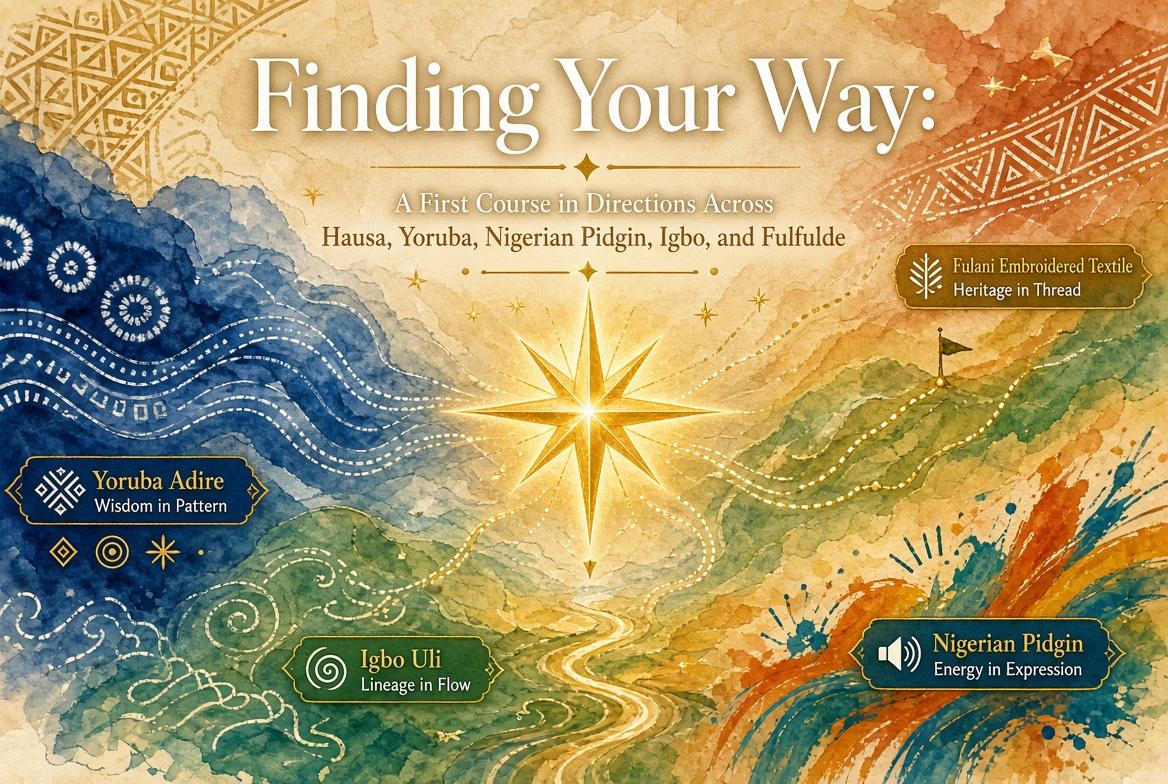
This course is about those directions. We are going to explore fifty questions and answers about finding your way across five languages: Hausa, Yoruba, Nigerian Pidgin, Igbo, and Fulfulde. These are the phrases you use when you are lost, when you are giving directions, and when you are simply trying to understand where you are in the world.
Let us begin with a truth: in many Nigerian languages, directions are given relative to landmarks, not to compass points. You do not say "go north." You say "go past the mosque, turn at the big tree, and continue until you see the market." The landmarks are the map. The story is the route.
So as we go through these fifty questions, do not just memorize the words. Learn to see the world the way these languages see it. Learn to navigate by memory, by story, by the kindness of the people you meet.
---
Asking for Directions
The first step in finding your way is admitting you are lost. These phrases help you ask for help with grace and clarity.
English Hausa Yoruba Pidgin Igbo Fulfulde
Excuse me Gafara Ẹ jọ̀wọ́ Abeg Biko Hakkilo
I am lost Na ɓata Mo ti sọnù I don lost Efunahụla m Mi majjii
Can you help me? Za ka iya taimaka mini? Ṣé o lè ràn mí lọ́wọ́? You fit help me? Ị nwere ike inyere m aka? A mbaawi wallude lam?
Where is...? Ina...? Níbo ni...wà? Where...dey? Ebee ka...dị? Toy...woni?
How do I get to...? Yaya zan isa...? Báwo ni mo lè dé...? How I go reach...? Kedu ka m ga-esi ruo...? No mi yottata...?
Is this the road to...? Wannan hanya ce zuwa...? Ọ̀nà yìí lọ sí...? This road go...? Ụzọ a na-aga...? Ndun laawol...?
Which way? Wace hanya? Ọ̀nà wo? Which way? Ụzọ ole? Ndee laawol?
I am looking for... Ina neman... Mo ń wá... I dey find... Ana m achọ... Mi nana…
Please show me Don Allah nuna mini Ẹ jọ̀wọ́ fi mí hàn Abeg show me Biko gosi m Achu hollu lam
I do not understand Ban gane ba Mi kò yé I no understand Aghọtaghị m Mi famaani
---
Giving Directions
Once you know how to ask, you need to know how to answer. These phrases help you guide someone with patience and precision.
English Hausa Yoruba Pidgin Igbo Fulfulde
Go straight Miƙe kai tsaye Lọ tààrà Go straight Gaa ozugbo Yahdu taƙa
Turn left Juya hagu Yí sí òsì Turn left Tụgharịa aka ekpe Yeeɓu nano
Turn right Juya dama Yí sí ọ̀tún Turn right Tụgharịa aka nri Yeeɓu ñaamo
Go back Koma baya Padà sẹ́yìn Go back Laghachi azụ Rutto ɓaawo
Continue Ci gaba Tẹ̀síwájú Continue Gaa n'ihu Jokku yahde
Stop here Tsaya nan Dúró níbí Stop here Kwụsị ebe a Dartu ɗoo
It is near Yana kusa Ó sún mọ́ E near Ọ dị nso Ɗum ɓadii
It is far Yana da nisa Ó jìn E far Ọ dị anya Ɗum woɗɗi
It is on the left Yana hagu Ó wà ní òsì E dey left Ọ dị n'aka ekpe Ɗum woni nano
It is on the right Yana dama Ó wà ní ọ̀tún E dey right Ọ dị n'aka nri Ɗum woni ñaamo
---
Landmarks and Places
In Nigeria, directions are often given by landmarks. These phrases help you identify the places that matter.
English Hausa Yoruba Pidgin Igbo Fulfulde
The market Kasuwa Ọjà Market Ahịa Luumo
The mosque Masallaci Mọ́ṣáláṣí Mosque Ụlọ alakụba Juulirde
The church Coci Ṣọ́ọ̀ṣì Church Ụka Ekklisaa
The school Makaranta Ilé-ìwé School Ụlọ akwụkwọ Duɗal
The hospital Asibiti Ilé-ìwòsàn Hospital Ụlọ ọgwụ Safrirde
The bank Banki Báńkì Bank Ụlọ akụ Banke
The police station Ofishin 'yan sanda Ọ́fíìsì ọlọ́pàá Police station Ụlọ ọrụ ndị uwe ojii Poste polis
The petrol station Gidan mai Ilé epo Petrol station Ebe mmanụ ụgbọala Nokku petirool
The roundabout Wurin juyawa Oríta Roundabout Ebe mgbanaka Nokku weerta
The junction Mahadar hanya Oríta Junction Nzụkọ ụzọ Nokku hawrugol
---
Directions by Distance and Time
Sometimes directions are given in minutes, not meters. These phrases help you talk about how far and how long.
English Hausa Yoruba Pidgin Igbo Fulfulde
Five minutes away Minti biyar Ìṣẹ́jú márùn-ún Five minutes Nkeji ise Minit jowi
Ten minutes away Minti goma Ìṣẹ́jú mẹ́wàá Ten minutes Nkeji iri Minit sappo
A short distance Nisa kaɗan Ìjìnnà díẹ̀ Small distance Obere anya Nisa seeɗa
A long distance Nisa mai tsawo Ìjìnnà púpọ̀ Long distance Ogologo anya Nisa tiiɗa
Walking distance Nisan tafiya Ìjìnnà ìrìn Walk distance Ebe ị ga-eje ije Nisa yahdu
Take a taxi Yi tasi Gba táksì Take taxi Were tagzi Naanu taksi
Take a bus Yi bas Gba ọkọ̀ Take bus Were ụgbọ ala Naanu oto
The next street Titin gaba Pópó tó ń bọ̀ Next street Okporo ụzọ na-esote Laawol garoowol
The last street Titin ƙarshe Pópó tó kẹ́yìn Last street Okporo ụzọ ikpeazụ Laawol sakkitiingol
Just around the corner Kusa da kusurwa Ní igun Around the corner N'akụkụ nkuku E saraa kaaƴe
---
Directions in the City and the Village
Directions change depending on where you are. The city has streets and traffic lights. The village has paths and trees. These phrases help you navigate both.
English Hausa Yoruba Pidgin Igbo Fulfulde
The main road Babbar hanya Ọ̀nà pàtàkì Main road Isi ụzọ Laawol mawngol
The bush path Hanyar daji Ọ̀nà igbó Bush path Ụzọ ọhịa Laawol ladde
The bridge Gada Afárá Bridge Àkwà mmiri Pon
The river Kogi Odò River Osimiri Maayo
The traffic light Hasken hanya Ìmọ́lẹ̀ òpópónà Traffic light ọkụ okporo ụzọ Lamɗam laawol
The bus stop Tashar bas Ibùdókọ̀ ọkọ̀ Bus stop Ebe ụgbọ ala na-akwụsị Nokku oto dartata
The park Filin ajiye motoci Páàkì Park Ebe a na-adọba ụgbọala Nokku oto ndaartata
The corner Kusurwa Igun Corner Nkuku Kaaƴe
The end of the road Ƙarshen hanya Ìparí ọ̀nà End of road Ọgwụgwụ ụzọ Timmoode laawol
The beginning of the road Farkon hanya Ìbẹ̀rẹ̀ ọ̀nà Beginning of road Mmalite ụzọ Fuɗɗoode laawol
---
When You Are Still Lost
Sometimes directions are not enough. Sometimes you need to ask again, or ask someone else, or simply accept that you are lost and enjoy the journey. These phrases help you in those moments.
English Hausa Yoruba Pidgin Igbo Fulfulde
I still do not understand Har yanzu ban gane ba Mi kò yé síbẹ̀ I still no understand Aghọtabeghị m Mi famaani haa jooni
Can you repeat that? Za ka iya maimaitawa? Ṣé o lè tún sọ ọ́? You fit repeat? Ị nwere ike ikwughachi? A mbaawi tunndude?
Please speak slowly Don Allah yi magana a hankali Ẹ jọ̀wọ́ sọ̀rọ̀ pẹ̀lẹ́ Abeg talk slow Biko jiri nwayọọ kwuo Achu haalu seeɗa
Can you show me on the map? Za ka nuna mini a taswira? Ṣé o lè fi mí hàn lórí máàpù? You fit show me for map? Ị nwere ike igosi m na map? A mbaawi hollude lam e kartal?
I will ask someone else Zan tambayi wani Mo máa béèrè lọ́wọ́ ẹlòmíràn I go ask somebody else M ga-ajụ onye ọzọ Mi lamndoto goɗɗo
Thank you for your help Na gode da taimakonka Ẹ ṣé fún ìrànlọ́wọ́ rẹ Thank you for your help Daalụ maka enyemaka gị Jaraama ballal ma
I will find my way Zan sami hanyata Mo máa rí ọ̀nà mi I go find my way M ga-achọta ụzọ m Mi yiytoto laawol am
It is okay Babu laifi Kò sí wàhálà No wahala Ọ dị mma Hakkilo alaa
I am grateful Ina godiya Mo dúpẹ́ I grateful Enwere m ekele Mi yettaama
Have a good day Yini mai kyau Ọjọ́ tó dára Have good day Ụbọchị ọma Ñalnde moƴƴere
---
The Grammar of Direction
The grammar of direction is the grammar of motion. It is about how we move through space and how we describe that movement.
In Hausa, the verb je means "to go." The verb zo means "to come." These are the two poles of motion. Zan je means "I will go." Zan zo means "I will come." The direction is built into the verb.
In Yoruba, the verb lọ means "to go." The verb wá means "to come." Mo ń lọ means "I am going." Mo ń bọ̀ means "I am coming." The verb carries the direction.
In Nigerian Pidgin, the verb go is used for the future. I go reach means "I will arrive." The verb dey is used for the present continuous. I dey come means "I am coming." The grammar is simple and direct.
In Igbo, the verb ga means "to go." The verb bịa means "to come." Ana m aga means "I am going." Ana m abịa means "I am coming." The direction is in the verb.
In Fulfulde, the verb yahde means "to go." The verb warde means "to come." Mi yahata means "I will go." Mi warta means "I will come." The direction is in the verb.
---
How to Practice Directions
You cannot learn directions from a book. You learn them by moving.
Get lost on purpose. Go to a part of your city you do not know. Ask for directions in the language you are studying. Follow them. Get lost again. Ask again.
Draw a map. Draw a map of your neighborhood. Label the landmarks in your new language. Practice giving directions to a friend.
Use landmarks. When you give directions, use landmarks. "Go past the mosque. Turn at the big tree. Continue until you see the market." This is how Nigerians give directions.
Listen to conversations. Listen to how people give directions in the market, on the street, at the bus stop. Pay attention to the gestures, the pauses, the repetitions.
Be patient. Learning directions takes time. You will make mistakes. You will get lost. But every mistake is a lesson. Every wrong turn is a step toward understanding.
---
The Fifty-First Question
There is one question that is not on the list. It is the question you ask yourself when you have learned all these phrases: Where am I going?
Directions are not just about finding a place on a map. They are about finding your place in the world. They are about knowing where you come from and where you are going. They are about the journey, not just the destination.
In Nigeria, there is a saying: Hanya ce ta fi muhimmanci fi wurin da za a je—the road is more important than the destination. It means that the journey teaches you more than the arrival. It means that getting lost is not a failure. It is an adventure.
So learn these phrases. Use them. But remember that the most important thing you can do when you are lost is not to find your way. It is to ask for help. It is to trust the stranger. It is to accept the kindness of the people you meet.
And that kindness needs no translation.
It is called hospitality.

Leave a comment
Your email address will not be published. Required fields are marked *