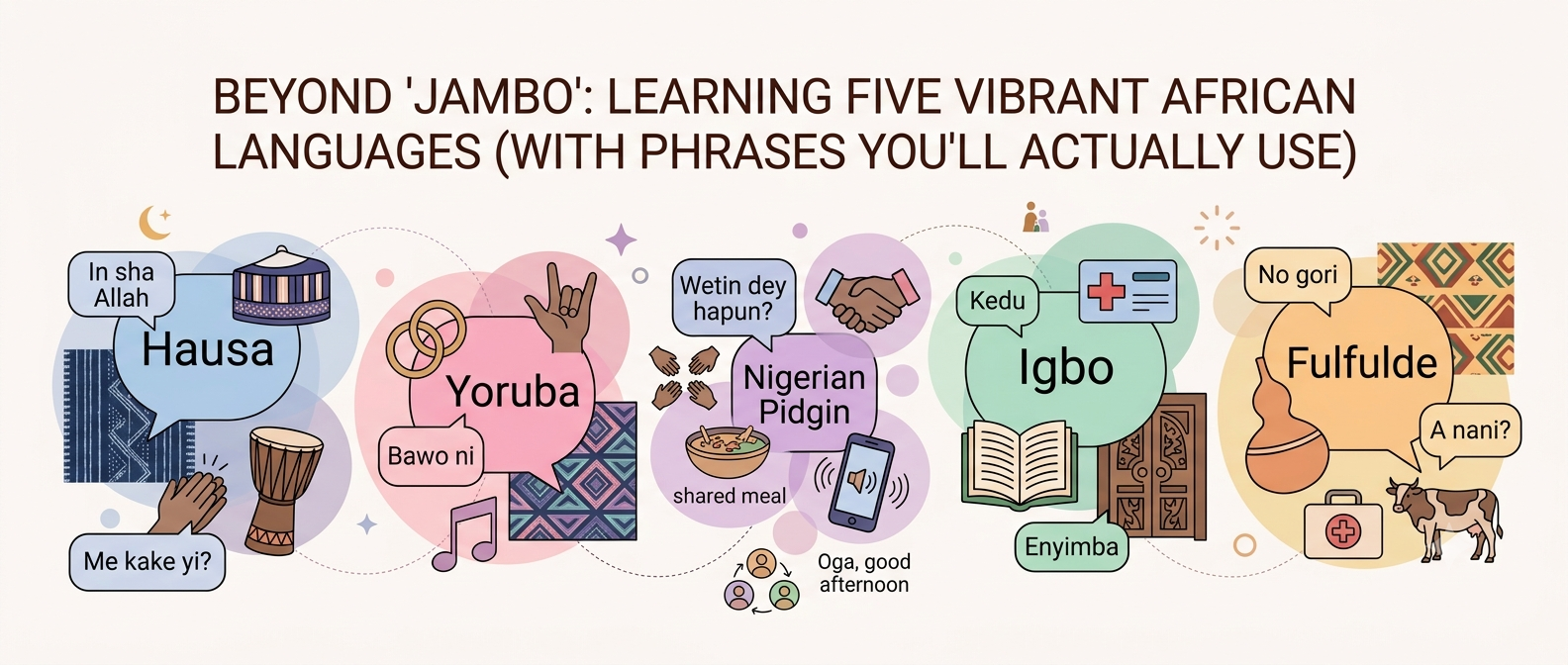
Africa is home to thousands of languages, each carrying its own history, traditions, expressions, and ways of communicating. Learning even a few words from another language can help you connect with people, appreciate different cultures, and approach unfamiliar situations with greater confidence.
You may already recognize Jambo, a greeting associated with Swahili. But there is much more to discover beyond this familiar word.
In this guide, we explore five African languages: Swahili, Oromo, Amharic, Fulfulde (also called Fulani in some contexts), and Lingala. You'll discover where these languages are spoken, learn useful introductory expressions, and find practical ways to begin learning them.
Whether you're preparing for a trip, exploring African cultures, or simply interested in languages, this guide will help you take your first steps.
1. Swahili: A Language That Connects East Africa
Swahili, also known as Kiswahili, is a major African language spoken across parts of East Africa. It is widely used in Tanzania and Kenya and also has speakers in neighboring countries.
Swahili is useful for travelers, students, and anyone interested in East African culture. Learning a few common expressions can make everyday interactions more comfortable.
Useful Swahili phrases
Swahili| English meaning
Habari?| How are you? / What's the news?
Hujambo?| How are you? (singular greeting)
Sijambo.| I'm fine.
Asante.| Thank you.
Asante sana.| Thank you very much.
Tafadhali.| Please.
Samahani.| Excuse me / Sorry.
Karibu.| Welcome.
Kwaheri.| Goodbye.
Try a short conversation
Person A: Habari?
Person B: Nzuri, asante.
Person A: Asante sana.
This is a simple example of how a greeting can lead into a friendly exchange. The exact expressions people prefer can vary by region and situation.
A useful learning tip
Learn greetings together with their natural responses. For example, practise Hujambo? and Sijambo as a pair rather than memorizing each expression in isolation.
For additional examples, consult established Swahili phrase references and listen to native speakers. The way a phrase sounds in natural conversation is just as important as remembering its written form.
2. Oromo: Discovering Afaan Oromoo
Oromo, commonly called Afaan Oromoo by its speakers, is a Cushitic language spoken primarily in Ethiopia, with speakers also living in neighboring countries.
It is an important language for understanding the cultures and everyday lives of Oromo communities.
Oromo greetings often involve asking about a person's well-being. Learning a few basic expressions can help beginners start conversations politely.
Useful Oromo phrases
Oromo| English meaning
Akkam?| Hello / How are you?
Akkam jirta?| How are you?
Akkam bulte?| Good morning; literally, asking how someone passed the night
Galatoomi.| Thank you.
Maaloo.| Please.
Eeyyee.| Yes.
Lakkii.| No.
Nagaatti.| Goodbye.
Forms of greetings and questions can change depending on whom you're addressing. Some expressions also have different forms for singular, plural, or respectful situations.
Practise a greeting
Person A: Akkam?
Person B: Nagaa. Ati hoo?
This is an introductory practice exchange. Because greetings may vary by dialect and context, have a fluent Oromo speaker check the wording before using it as a formal teaching example.
What should beginners focus on?
Start with greetings, polite expressions, and simple questions. Once you are comfortable with those, practise introducing yourself and asking for directions.
Try learning a few words each day rather than memorizing a long vocabulary list at once.
3. Amharic: Exploring Ethiopia's Rich Linguistic Heritage
Amharic is a Semitic language spoken primarily in Ethiopia. It has a distinctive writing system known as the Ethiopic script, which makes it particularly interesting for learners who have previously studied languages written with the Latin alphabet.
Beginners can start with greetings and everyday expressions before gradually learning the writing system.
Useful Amharic phrases
The following examples use a simplified Latin transliteration. Transliteration systems can differ, so the spelling below should be treated as a learning aid rather than a complete pronunciation guide.
Amharic transliteration| English meaning
Selam.| Hello.
Endemin neh?| How are you? — addressed informally to a man
Endemin nesh?| How are you? — addressed informally to a woman
Dehna negn.| I am fine.
Ameseginalehu.| Thank you.
Awo.| Yes.
Yellem.| No / There isn't, depending on context.
Amharic has distinctions that English speakers may not expect. For example, an informal question can differ depending on the person being addressed. Polite or respectful forms may be more suitable in other situations.
A practical way to begin
Learn to recognize the Amharic script alongside the transliteration.
Instead of relying entirely on English-letter approximations, listen to recordings from native speakers and compare the sounds with the written forms.
You can also begin with a small goal: learn a greeting, understand its response, and practise saying both aloud until they become familiar.
4. Fulfulde: Exploring a Language Across Communities
Fulfulde is a language associated with Fulani communities across several parts of West and Central Africa. The names Fulfulde, Pulaar, and Pular are used in different regional and linguistic contexts, and they should not automatically be treated as interchangeable in every situation.
The language is used across a wide geographical area, and its vocabulary, pronunciation, and expressions vary among communities.
That variation makes it important to learn the form used by the people you want to communicate with.
How should beginners approach Fulfulde?
Rather than assuming one phrase will be appropriate everywhere, start by identifying the regional variety you want to learn.
A beginner could organize their first lessons around these topics:
- Greetings and asking about someone's well-being.
- Introducing yourself and your family.
- Thanking someone and making polite requests.
- Asking for directions.
- Buying items at a market.
- Understanding common responses.
Build a useful vocabulary list
Create a notebook with three columns:
English| Fulfulde expression| Notes
Hello| Add a verified regional expression| Note the region and pronunciation
Thank you| Add a verified regional expression| Confirm spelling with a fluent speaker
Please| Add a verified regional expression| Check how it is used naturally
Goodbye| Add a verified regional expression| Record whether it is formal or informal
This table is intentionally a verification exercise rather than a list of unconfirmed translations.
Once you have identified the regional variety, use a reliable dictionary, an established learning resource, or a fluent speaker to fill in the expressions.
The aim is not simply to collect words. It is to learn expressions that people actually use in the community you're interested in.
5. Lingala: A Language of Music and Everyday Communication
Lingala is a Bantu language widely used in the Democratic Republic of the Congo and the Republic of the Congo. It is particularly recognizable through its presence in music and popular culture.
For learners, Lingala offers an opportunity to explore everyday expressions while discovering the cultural settings in which the language is used.
Useful Lingala phrases
Lingala| English meaning
Mbote.| Hello.
Sango nini?| What's the news? / What's happening?
Ozali malamu?| Are you well?
Nazali malamu.| I am well.
Matondi.| Thank you.
Kende malamu.| Go well / Goodbye.
As with the other languages in this guide, regional usage and context matter. A phrase that works in one conversation may not be the most natural choice in another.
Learn Lingala through listening
Music can be an enjoyable way to become familiar with the sounds and rhythm of Lingala. However, understanding a song is different from understanding an everyday conversation.
Combine listening with beginner lessons that explain vocabulary and grammar.
When you hear a phrase you like, write it down, find out what it means, and check how it is used outside the song. This will help you avoid relying on translations that don't fit ordinary conversation.
How to Start Learning an African Language in Seven Days
You don't need to memorize hundreds of words before you begin using a language. A small, consistent routine can help you develop a foundation.
Here is a simple seven-day plan that works for any of the five languages in this article.
Day 1: Learn five basic expressions
Choose a greeting, a question, a polite expression, a thank-you phrase, and a farewell.
Listen to the expressions spoken by a fluent speaker and repeat them aloud.
Day 2: Practise pronunciation
Focus on the sounds that differ from those in your first language.
Record yourself speaking and compare your pronunciation with a reliable audio example.
Day 3: Learn how to introduce yourself
Find verified expressions for saying your name and explaining where you come from.
Practise introducing yourself without reading directly from your notes.
Day 4: Learn a short conversation
Use two or three exchanges between speakers. Understand the meaning of each sentence rather than memorizing sounds without context.
Day 5: Study useful vocabulary
Learn words connected to your daily life, such as food, family, transport, school, or work.
Choose vocabulary that reflects the situations in which you expect to use the language.
Day 6: Listen to native speakers
Listen to a short recording, conversation, interview, or beginner lesson.
Try to identify words you already know. Don't worry if you cannot understand every sentence.
Day 7: Review and practise
Return to everything you learned during the week.
Try to greet someone, introduce yourself, and complete a short conversation using the expressions you have studied.
If possible, ask a fluent speaker to correct your pronunciation and explain any mistakes.
Common Mistakes Beginners Should Avoid
Learning a language involves more than remembering translations. A few common mistakes can make the process unnecessarily difficult.
1. Assuming every language has one standard greeting
Languages have regional varieties and different levels of formality. Learn which expression fits the community and situation.
2. Relying entirely on written pronunciation guides
English spelling cannot represent every sound in African languages accurately. Use audio recordings and native-speaker examples whenever possible.
3. Memorizing words without understanding the context
A word can have several meanings or be appropriate only in certain situations. Learn phrases in complete sentences.
4. Expecting fluency after a few days
A week of practice can help you build a foundation, but developing conversational ability requires continued listening, speaking, reading, and review.
5. Learning from unverified translations
Online phrase lists can contain spelling errors, unnatural expressions, or incomplete explanations. Compare multiple reliable references before relying on a translation.
Where Can You Continue Learning?
Here are several resources to explore:
- Omniglot: A reference for writing systems, language information, and useful phrases.
- Foreign Service Institute language materials: Educational resources that include language-learning lessons, such as Amharic.
- Native-speaker lessons: Audio and video lessons can help you understand natural pronunciation and everyday usage.
- Language dictionaries: Choose dictionaries that identify the language variety and explain the meaning of expressions.
- Community language classes: Where available, lessons with fluent speakers can provide feedback that written resources cannot.
When choosing a resource, check who produced it, whether its examples are reviewed, and whether the material covers the specific variety you want to learn.
Final Thoughts: Start With a Few Words
Swahili, Oromo, Amharic, Fulfulde, and Lingala offer different ways to explore the linguistic diversity of Africa.
You don't need to learn all five languages at once. Choose one that interests you, learn a handful of useful expressions, and practise consistently.
Remember that a language is more than a collection of translated words. It carries meaning through context, pronunciation, relationships, and everyday interactions.
Approach each language with curiosity and respect. Learn from reliable resources, listen to fluent speakers, and be willing to correct your mistakes.
Your first few words may be simple, but they can be the beginning of a much deeper learning experience.
Which of these five languages would you most like to learn first: Swahili, Oromo, Amharic, Fulfulde, or Lingala?
Share your choice and what interests you about the language.

Leave a comment
Your email address will not be published. Required fields are marked *